

Estimated reading time: 15 minute(s)
Nonprofit compliance isn’t always as straightforward as it seems.
While most organizations focus on maintaining their tax-exempt status and meeting annual filing requirements, certain types of income can introduce additional obligations that are easy to overlook. These situations often arise when revenue doesn’t directly align with the organization’s primary purpose.
At the federal level, unrelated business income (UBI) is reported using Form 990-T. However, some states require separate reporting for that same income.
California is one of them, and that’s where CA Form 109 comes in.
What is Form 109?
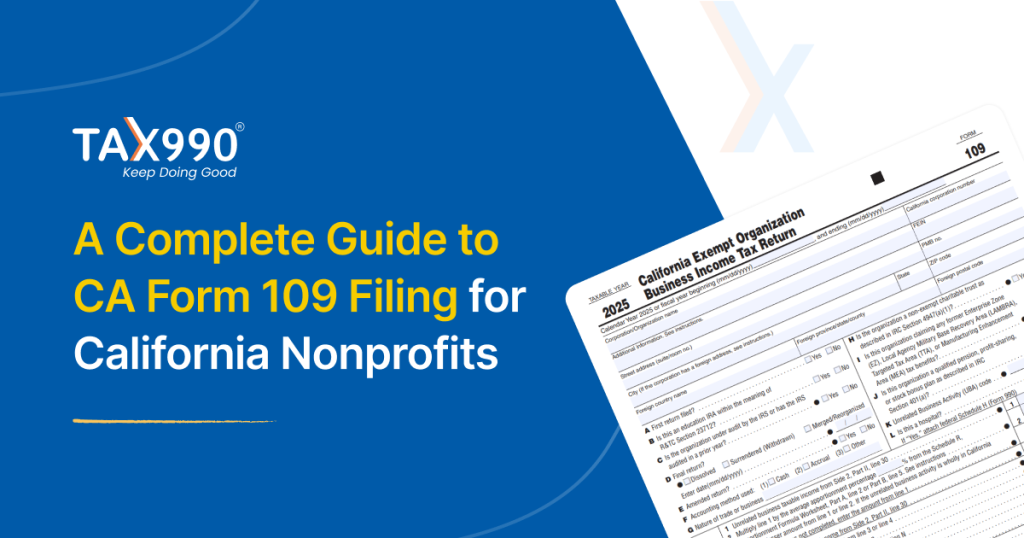
CA Form 109, officially known as the California Exempt Organization Business Income Tax Return, is used by tax-exempt organizations to report unrelated business income (UBI) earned within California.
Even if your organization is exempt from income tax, any income generated from activities not substantially related to your exempt purpose is considered taxable at the state level.
Examples of UBI include:
- Rental income from debt-financed property
- Advertising income
- Income from selling merchandise or operating a business unrelated to the mission
- Certain ticket sales or event income
Who must file Form 109?
Your organization is required to file CA Form 109 if:
- It is exempt under California tax law (for example, organizations filing CA Form 199), and
- It has over $1,000 in gross unrelated business income generated in California.
This threshold mirrors federal filing requirements for IRS Form 990-T. If the organization must file a federal Form 990-T for UBI, it typically must file CA Form 109 at the state level as well.
Even if your organization files a federal return, you must also file a separate California Form 109 if the income was earned in the state.
Information reported to complete Form 109
The form requires organizations to report the following information:
1. Unrelated Business Income (UBI)
This includes all taxable income generated from activities not related to the organization’s exempt mission.
2. Allowable Deductions
Organizations may deduct expenses directly connected with producing UBI, such as:
- Cost of goods sold
- Staff wages
- Operational expenses
- Depreciation
3. Taxes and Credits
After calculating taxable income, the organization applies the appropriate tax rates and reports credits if applicable.
4. Payments and Withholding
Any estimated tax payments or withholding should also be reported.
5. Final Tax Due or Overpayment
The form calculates whether the organization owes additional tax or is due a refund.
When is Form 109 due?
The due date generally aligns with the due date of federal Form 990-T, and depends on your organization type.
For most organizations, Form 109 is due on or before the 15th day of the 5th month following the close of the taxable year. This means the deadline for calendar filers is May 15.
For certain organizations (such as employees’ trusts under IRC Section 401(a), IRAs, and Coverdell ESAs), the due date is the 15th day of the 4th month after the end of the taxable year. This means the deadline for calendar filers is April 15.
Automatic extensions to file the form are available, but they do not extend the time to pay any taxes owed.
Is there an extension available for Form 109?
If your organization cannot file the CA Form 109 by the original due date, California provides an automatic 6-month extension to file the return. No separate application is required.
However, there are important conditions:
- The organization must be in good standing on the original due date
- Organizations that are suspended or not in good standing are not eligible for the extension
Additional filing requirements
Filing CA Form 109 may require additional schedules and supporting forms depending on your organization’s activities, income sources, and tax position. These are not always mandatory—but when applicable, they are essential for accurate reporting and compliance.
Key schedules to be aware of
- Schedule R – Apportionment Formula Worksheet
Required when your unrelated business income is generated both inside and outside California. This schedule helps determine the portion of income taxable in California using an apportionment formula. - Schedule B – Tax Credits
Used to report any applicable tax credits. Supporting credit forms must also be attached when claiming credits. - Schedule K – Credit Recapture
Required if your organization needs to recapture previously claimed credits, such as California Competes Credit or other state incentives.
Learn more about all the schedules
Additional forms that may apply
- FTB 3885F – Depreciation and Amortization
Required to calculate and report depreciation differences between federal and California rules for assets used in generating UBI. - FTB 3801 / 3802 – Passive activity loss limitations
- Schedule P (100 or 541) – Alternative Minimum Tax (AMT) computations
- FTB 3805Q (or related forms) – Net Operating Loss (NOL) calculations
Unlock seamless Form 109 reporting with Tax990
CA Form 109 is an essential filing for tax-exempt organizations that generate unrelated business income in California. Understanding the requirements and filing correctly ensures your organization remains compliant while continuing to focus on its mission.
Tax990 supports the e-filing of CA Form 109 for California organizations. With built-in calculations, step-by-step guidance, and AI support, nonprofits can report UBI quickly and accurately, reduce errors through smart validation checks, and save time with simplified workflows.
Explore how Tax990 simplifies CA Form 109 filing

Leave a Comment