

Estimated reading time: 27 minute(s)
If you’re a CPA, an enrolled agent, or a paid preparer shopping for IRS approved software for tax preparers, you’ve probably seen the phrase “IRS-approved” or “IRS-authorized e-file provider” on every vendor’s site. But what does that actually mean and why does it matter which software you choose?
This guide explains how electronic filing really works from end to end, the various roles that are involved in the e-file process, why IRS authorization matters, and the questions to ask before you buy.
How Electronic Filing Actually Works: The MeF System
Behind almost every e-filed federal return is the IRS Modernized e-File (MeF) system. MeF is a web-based platform that accepts corporate, individual, partnership, exempt organization, and excise tax returns over the internet using a standardized XML format. The 990 family of forms which nonprofits file has been on the MeF platform since 2004.
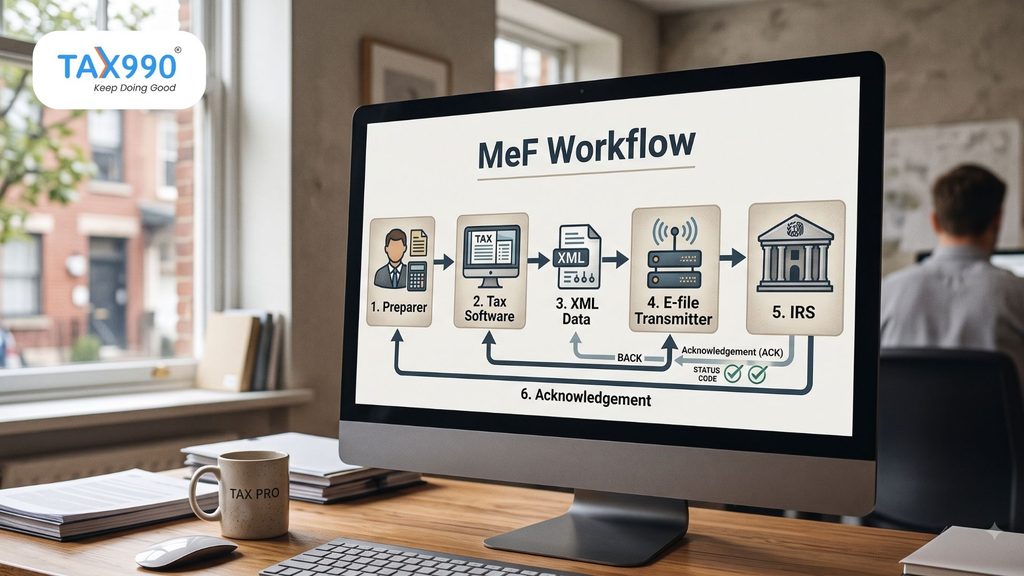
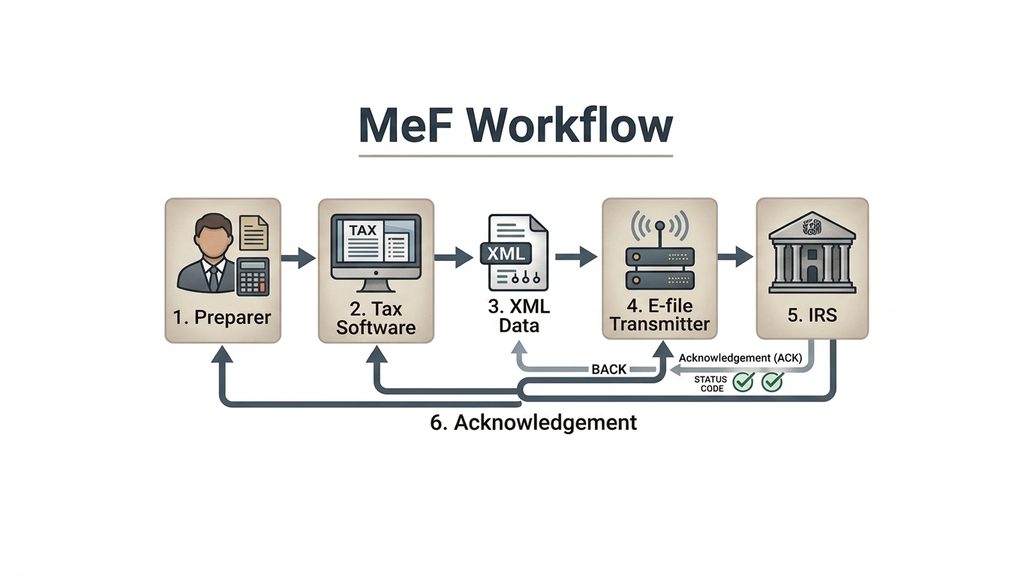
Here’s the end-to-end flow in plain terms:
- You, as a tax preparer, complete a return in software (like Tax990).
- The software converts the return into IRS-specified XML.
- A transmitter (like Tax990) sends that XML directly to the IRS over a secure connection.
- The MeF system validates the returns in the transmission file and creates an acknowledgment file within 24 hours for each one either “accepted” or a reject file with error codes.
What “IRS-Authorized e-File Provider” Means and the Roles Involved
“Authorized IRS e-file Provider” is an umbrella term that can apply to several distinct roles. A single organization can play more than one role. Understanding these roles helps you read software vendor claims accurately:
- Electronic Return Originator (ERO) — originates the electronic submission of returns.
- Transmitter — sends the electronic return data directly to the IRS. A transmitter must have software and systems that interface with MeF.
- Intermediate Service Provider (ISP) — processes return information between an ERO (or taxpayer) and a transmitter.
- Software Developer — writes software that formats returns to IRS specifications and/or transmits them.
- Reporting Agent — an accounting service, bank, or similar entity authorized to file certain returns (often payroll/employment tax) on a client’s behalf.
These roles are not mutually exclusive — an ERO can also be a transmitter and a Software Developer at the same time. But they are distinct functions, and that distinction is exactly what matters when comparing IRS tax prep software.
Tax990 illustrates the overlap. We develop the software and transmit 990-series returns directly to the IRS. We also support the preparer workflow including 8879-TE signature requests. If your firm holds an EFIN as an ERO, you originate the submission, and we handle transmission; if you’re filing for your own organization, you’re the filer and the same transmission path applies.
What It Takes to Become an Authorized e-File Provider
Becoming an IRS-authorized e-file provider isn’t a form you fill out over lunch. The IRS runs rigorous checks to confirm that providers are legitimate, and you don’t have to take any vendor’s word for it, including ours. The IRS publishes a list, by tax year, of companies that have passed its testing requirements for exempt organization returns. Look us up.
There are two layers of authorization behind every e-filed 990.
Layer one: what your firm has to do
This part is yours, and no software vendor can do it for you. You need to acquire an EFIN before you can begin to file forms.
- A PTIN for every preparer in the firm applied for individual, renewed annually, expiring December 31st each year.
- An IRS e-Services account for each principal and responsible official, with identity verification through ID.me for anyone holding a Social Security number.
- A completed online e-file application with the correct provider role selected. Return preparers who want to e-file for clients select ERO. Don’t select “Online Provider” — that’s a separate designation for providers offering filing directly to taxpayers, and choosing it means starting over.
- Fingerprinting for anyone not credentialed. Principals and responsible officials who are attorneys, CPAs, or enrolled agents submit their professional credential information instead. Everyone else is fingerprinted electronically through the IRS-authorized vendor at no charge, scheduled from the link on the e-file application summary page.
- A suitability check covering credit history, tax compliance, criminal background, and any prior e-file non-compliance for the firm and for each principal and responsible official individually.
- An acceptance letter carrying your EFIN.
Timeline: up to 45 days from submission for IRS approval. Apply well before filing season — delayed fingerprinting is the single most common cause of a slow application. Forty-five days in October is a formality; forty-five days in March is a missed deadline.
That’s a real process, but it’s finite. You do it once, and then you’re an ERO.
Layer two: what a transmitter has to do every single year
If authorization stopped at the EFIN, every firm would transmit its own returns. Tens of thousands hold EFINs. Almost none transmit, because originating a return and transmitting it are two different authorizations.
A transmitter needs an ETIN on top of its EFIN, plus a registered System ID for direct machine-to-machine transmission. It must pass IRS Assurance Testing System (ATS) testing before each filing season, against schemas and business rules that change annually, with separate testing for every software package. Infrastructure shifts underneath you too: when MeF dropped SHA-1 from its signature requirements, every connected system had to change or stop working. And the exempt organization program is wide. Tax990 covers 990, 990-EZ, 990-PF, 990-N, 990-T, 8868, 1120-POL, 8038-CP, plus the required schedules and supplemental forms.
Where Tax990 fits
Your firm handles layer one. Tax990 carries layer two.
- We hold the authorization and do the annual work — the ETIN, each season’s ATS cycle, schema rewrites, business-rule updates, cryptographic upkeep. When the IRS changes a schema in November, that’s our problem.
- The full 990 series in one place — 990, 990-EZ, 990-PF, 990-N, 990-T, 8868, 1120-POL, 8038-CP, CA Form 199 and CA Form 109 with required schedules attached automatically, at no extra cost.
- Rejections cost you nothing — Our internal error check tests against IRS business rules before transmission. If the IRS still rejects your return, you can correct and retransmit for free. Amendments and extensions too.
- Verifiable on more than one register — IRS-approved, FTB-approved for CA 199, SOC 2 certified, with two-factor authentication and encrypted PII.
- Support that can read the IRS response — U.S.-based live chat, phone and email, with extended hours at peak.
Why Only Authorized Transmitters Can Submit 990s and What That Means for Your Software Choice
Only an IRS-authorized transmitter can push a 990-series return into MeF. That’s a hard technical and regulatory fact, and it creates a practical distinction between products that look identical from the outside:
- Direct transmitters send your return from their own platform straight to the IRS. Tax990 operates this way.
- Resellers route your return through a third-party transmitter.
Both models can be legitimate, and plenty of preparers use resellers without incident. But the difference shows up in two places that matter most when a deadline is coming.
- Accountability. MeF returns rejection and error codes to whoever holds the connection. This means the direct transmitter is going to have a clearer idea of what’s going on than the third party.
- Turnaround. Every intermediary hop adds lag time both ways. When a return is rejected at 4 p.m. on May 15, that lag can make or break compliance
So ask plainly: do you transmit directly, or route through a third party?
The 990 E-File Mandate: Why This Matters if You Have Nonprofit Clients
If you serve nonprofit clients, paper filing is no longer an option. The Taxpayer First Act requires tax-exempt organizations under Section 501(a) to file 990-series returns electronically (Section 2301). The rollout was phased:
- Form 990 and 990-PF: required electronically for tax years beginning after July 1, 2019.
- Form 990-EZ: per the IRS “Annual filing and forms” page, “Form 990-EZ filers are required to file electronically for tax years ending July 31, 2021, and later.”
- Form 990-N: already electronic-only.
An organization that is required to file electronically and instead submits on paper is treated as not having filed at all. Can start the clock toward auto-revocation of exempt status after three consecutive missed years.
There’s also a limit that catches preparers by surprise: electronic filing is only available for the current tax year and two prior tax periods. So a client with several years of unfiled returns presents a split path. The recent years must be e-filed, while the oldest years can only be paper filed.
For preparers, the takeaway is simple: you need software that e-files and transmits the full 990 series.
The Bottom Line
“IRS-approved” isn’t marketing fluff. It reflects a real authorization structure built on the MeF system. As a preparer, keep three things straight:
- Your PTIN which identifies you
- Your firm’s EFIN which authorizes you to originate returns and
- An authorized transmitter (Tax990) can actually deliver a 990 to the IRS.
You’ll always own the first two. The third is worth choosing carefully and worth asking a direct question about. If you have nonprofit clients, the e-file mandate means your software choice isn’t cosmetic, so ask vendors whether they transmit directly, verify them against the IRS provider list, and decide from there.

Leave a Comment