Nonprofit Board Meeting Agenda Best Practices: Stop Wasting Board Time
Estimated reading time: 26 minute(s)
Most nonprofit boards don’t have an engagement problem. They have a time problem. A nonprofit board meeting agenda is a governance plan that reserves the board’s limited time for the decisions, discussions, and learning only the full board can handle.
Everything else belongs somewhere other than the full board meeting: a committee, a written report, or a consent agenda. Get that division wrong and the cost shows up as turnover. The fastest way to build a disengaged board is to let capable members sit through meetings that don’t need them, and good people who join, serve six months, and step off usually leave because the time wasn’t worth it.
That was the argument in our September 22 webinar, “Stop Wasting the Board’s Time,” featuring Adam Bratton, Executive Director of The Nonprofit Partnership and a certified nonprofit board consultant through BoardSource.
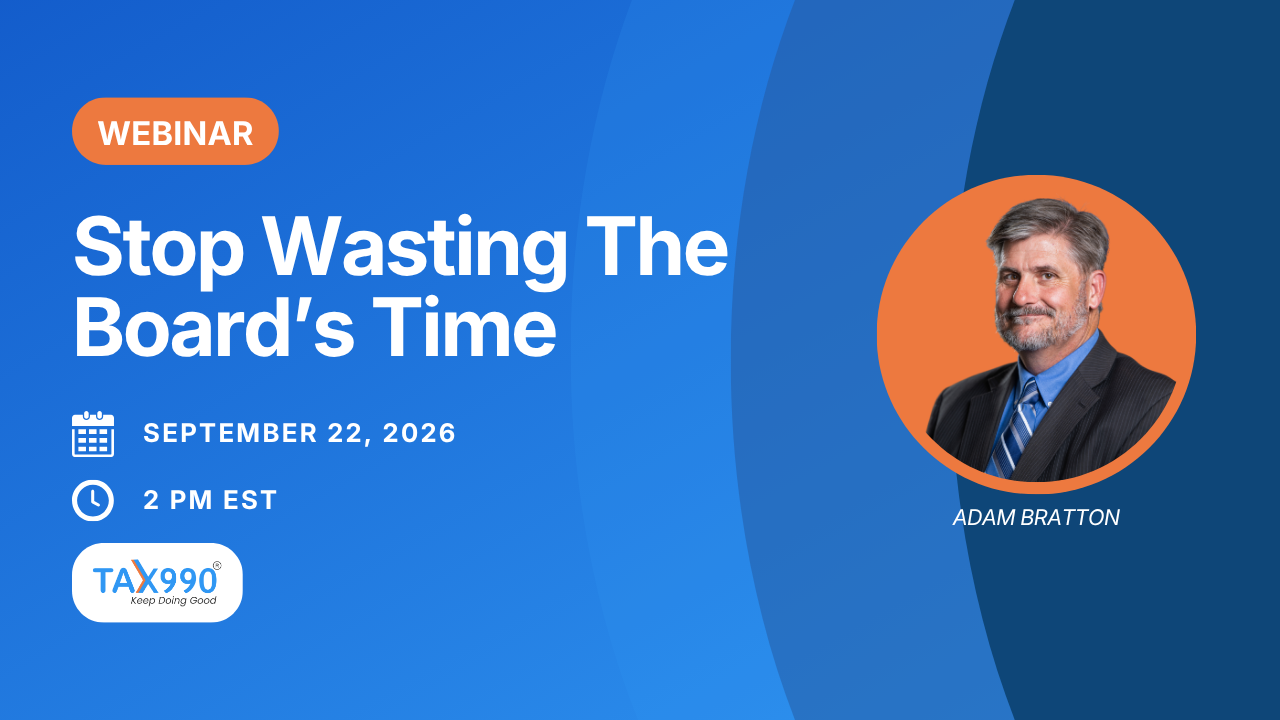
Watch the Full Webinar
Adam walks through the agenda structure, the committee handoffs, and the facilitation moves in about an hour. Watch “Stop Wasting the Board’s Time” on demand.
What Should Be on a Nonprofit Board Meeting Agenda?
Every item should do one of four things:
- Prompt a discussion the full board needs to have
- Produce a decision only the board can make
- Teach the board something it needs in order to govern
- Pass routinely on a consent agenda
If an item does none of those, communicate it another way.
The learning piece gets skipped most often. Most board members are professionals in their own fields, not governance experts, and very few have been trained in how to be a good board member. Adam recommends building short teaching moments into the agenda, such as walking the board through how to read audited financial statements and Form 990 in the months before those documents arrive.
He also offered a structural warning. Boards that meet every month rarely become effective, because the calendar turns into a cycle of meeting and then preparing for the next meeting. Four to six well-prepared meetings a year leave room for the committee work, preparation, and follow-through that make the full board meeting worth holding.
Which Decisions Belong to the Board, and Which Belong to Staff?
Adam named role confusion as the single biggest source of wasted board time. His shorthand: the board is about the future, and staff is about the present and the past. One attendee, Amy, summed it up in the chat as “staff is for now, board is for the future.”
| The board owns | Staff owns |
|---|---|
| Future direction and strategic choices | Implementation and execution |
| Financial sustainability and significant risk | Day-to-day operations and schedules |
| Organizational capacity and how strategy gets resourced | Present performance and reporting |
| Oversight, policy, and fiduciary duty | Management problems and staffing decisions |
That split is why Adam is so insistent about committees. A finance committee can research assumptions, test them, and develop options, so the full board receives key facts and a recommendation instead of line items. The board still discusses it, still challenges the recommendation, and still decides. It just doesn’t do the research in the room.
His example was the annual budget. The board has to approve one, but it doesn’t need to work through salaries, benefits, and line-item trends together to do that. A two-page summary with options and a recommendation gets the board to a better decision than a three-page set of committee minutes.
How Do You Build a Nonprofit Board Meeting Agenda Backward?
You start with the outcome you need and work back to the agenda, rather than copying the last meeting’s format. Adam walked through the sequence:
- Name the outcome. Write down what the board needs to have decided, discussed, or learned by the time the meeting ends.
- Identify the real questions. Decide which of those items genuinely require full board discussion rather than committee or staff work.
- Prepare the board in advance. Send the packet early enough to read, roughly two weeks out, with committee materials due to whoever assembles the packet about a week before that.
- Protect the largest block. Give the discussion and decision work the biggest share of the agenda, with time allotments attached until the board adjusts to the format.
- Move everything else. Route the rest to a committee, a written report, or the consent agenda.
Before an item earns full board time, Adam applies a meeting worthiness test.
- Does it require the full board’s authority, oversight, or collective decision making?
- Is there a meaningful question, choice, or tradeoff inside it?
- And has enough work been done beforehand that the board can actually decide?
That last question is the one organizations fail most often. Bringing a large decision to the board before any staff or committee work has happened forces the board to work through it, defer it, and then revisit it later.
What Belongs on a Consent Agenda?
A consent agenda is one package, one motion, and one vote covering routine items that need no separate discussion. It exists to protect the largest block of meeting time for the discussion and decision work only the board can do.
- Previous meeting minutes
- Routine reports
- Upcoming meeting dates
- Standard items that carry no real question
One point of Adam’s runs against common practice. Many sample agendas put the treasurer’s financial statement on the consent agenda, and Adam argues it should stay off. Financial review is oversight work, and oversight deserves its own conversation. Strategic decisions, anything carrying significant risk, and policy matters stay on the discussion agenda for the same reason.
The safety valve makes the practice safe to adopt: any board member can ask for an item to be pulled from consent and discussed before the vote. Adam’s experience is that the option rarely gets used, and that having it is what lets boards trust the format.
A well-built agenda still fails without facilitation, so he spent time there too. He walked through using a round robin so quieter members contribute, assigning a devil’s advocate when a collegial board slips into agreement, and closing rabbit holes without punishing the person who opened one.
Two Moments From the Session Worth Watching in Full
The most vital section of the webinar to watch in full is Adam’s example on how a chief executive asks the board for staffing. His instinct as a CEO is to walk in and say the organization needs two more positions. He then rewrites that request as a single strategic question, and the reframed version turns a yes-or-no vote into a discussion about capacity, tradeoffs, and the strategic plan. Watching him build the reframe step by step is what makes it usable in your own next meeting.
The other is from the live Q&A. An attendee asked what size board a genuinely small nonprofit needs, and Adam’s answer tied the number directly to how many committees it takes to do the board’s work, with a specific range attached. He also shared what happened to an organization whose board shrank unexpectedly, and why he cautions against very small boards no matter how well they function.
Both Moments Are in the Recording
The reframed capacity question and the board size answer are worth hearing in Adam’s own words. Watch the full session on demand.
How Board Meeting Habits Show Up on Form 990
Governance practice isn’t only an internal matter. Form 990 asks your organization to describe it in writing, and the answers become public.
Part VI of Form 990 covers governance, management, and disclosure. Section A asks whether the organization contemporaneously documented the meetings and actions of its governing body and each committee with authority to act on its behalf. Section B asks whether a complete copy of Form 990 was provided to every member of the governing body before the return was filed, and asks you to describe the review process.
Those questions reward exactly the habits Adam described. Real committees produce real minutes. A board that receives its packet two weeks early is a board that can review Form 990 before it’s filed rather than after. The IRS has published its own guidance on governance and related topics for 501(c)(3) organizations, and the classification for 501 organizations itself is defined at 26 U.S.C. § 501.
If you want the form-level detail, our walkthrough of Form 990 Parts 4 through 6 covers what each governance question is asking, and you can e-file Form 990 with Tax990 once your board has signed off. You can also read the IRS Instructions for Form 990 directly, and check your timing against our complete guide to Form 990 deadlines.
How Do You Know if Your Board Meetings Are Improving?
Ask the board. Adam recommends a short, anonymous survey after each meeting, either a one-minute poll before people log off or a brief follow-up sent while impressions are still fresh.
He made the case for anonymity from experience. A board chair and CEO can walk out of a meeting convinced it went well while the rest of the room felt otherwise, and the only way to catch that gap is to ask in a format that invites an honest answer.
Follow-through is the other half. A decision without a named owner, a deadline, and a report back to the board isn’t closed, which is how boards end up asking whether they already settled something six months ago. Adam’s position is blunt: a decision nobody followed through on was never really a decision.
When your board’s preparation is in good order, filing becomes the easier half of the job. Tax990 supports the full 990 series with a guided workflow, built-in error checks, and free retransmission of rejected returns, and every return is backed by the Tax990 Commitment with Protection Plus audit defense included automatically at no additional cost.
Get the Session and the Board Toolkit
The recording comes with the toolkit Adam referenced in the description of the registration page. Watch the webinar and get the toolkit.
You can see what else is coming on our 2026 nonprofit webinar lineup.
Leave a Comment