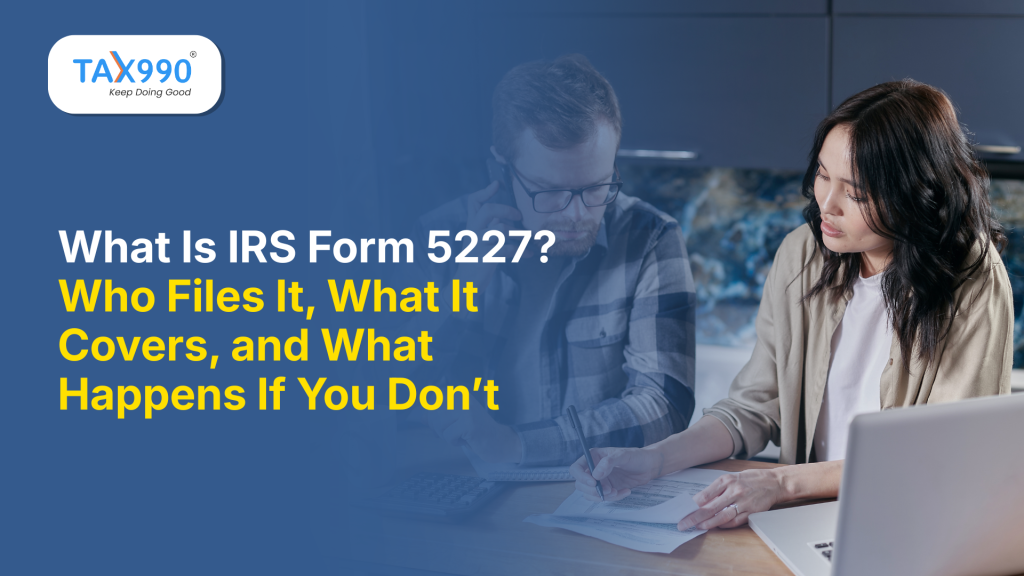
What Is IRS Form 5227? Who Files It, What It Covers, and What Happens If You Don’t
Estimated reading time: 14 minute(s)
If your organization works with charitable remainder trusts, pooled income funds, or charitable lead trusts, Form 5227 is probably already on your radar. Unlike most information returns, this one carries real personal exposure for trustees, not just the trust itself.
What is Form 5227?
Form 5227, Split-Interest Trust Information Return, is the IRS’s annual reporting form for split-interest trusts. It replaced the older Forms 1041-A and 1041-B and now serves as the single return where trustees report a trust’s financial activity, charitable distributions, and deductions.
This is also where the IRS determines whether the trust should be treated as a private foundation subject to Chapter 42 excise taxes.
Who Has to File It?
Form 5227 applies to any trust that qualifies as a “split-interest trust”, meaning it has both a charitable and non-charitable beneficiary. Specifically, filing is required for:
- Charitable Remainder Trusts (CRTs) under Section 664, including both Charitable Remainder Annuity Trusts (CRATs) and Charitable Remainder Unitrusts (CRUTs)
- Pooled Income Funds described in Section 642(c)(5)
- Other split-interest trusts, such as Charitable Lead Trusts (CLTs), that meet the definition under Section 4947(a)(2)
Also note that the organization’s trustee is responsible for filing it on behalf of the trust itself.
What Does Form 5227 Cover?
Form 5227 is broken into several parts, each capturing a different layer of the trust’s financial and compliance picture:
- Part I – Income and Deductions: Reports the trust’s income (interest, dividends, capital gains, etc.) and related deductions for the tax year, along with an accumulation schedule tracking undistributed income.
- Part II – Balance Sheet: Captures the trust’s assets, liabilities, and net assets at the beginning and end of the year, including the fair market value of trust corpus.
- Part III – Distributions: Details amounts distributed to both charitable and non-charitable beneficiaries during the year.
- Part IV – Private Foundation & Chapter 42 Questions: A series of yes/no questions used to flag potential excise tax exposure under the private foundation rules.
- Schedule A – Character of Distributions: Breaks down what portion of distributions to non-charitable beneficiaries counts as ordinary income, capital gains, other income, or trust corpus.
- Schedule B – Distributable Income (CRUTs only): A separate worksheet used specifically by Charitable Remainder Unitrusts to calculate the unitrust amount owed for the year.
Knowing which schedules actually apply to your trust type avoids a common mistake: treating Form 5227 as a single uniform return when large parts of it only apply to certain trust structures.
When is the Form 5227 Deadline?
For calendar-year trusts, Form 5227 is due on the 15th of the 4th month after your calendar/fiscal year ends. A six-month extension is available using Form 8868, filed by the original due date.
One filing detail that trips people up: if the trust (or trustee) is required to file 10 or more returns of any type in the calendar year, Form 5227 must be filed electronically.
What Happens If You Don’t File?
The statutory base penalty imposed on split-interest trust returns is $25 per day, up to $10,000 per return. If the trust has gross income greater than $327,000, the penalty increases to $130 for each day that the failure continues, with a maximum of $65,000 for any one return. Reasonable cause can offer relief, but has to be established.
Trustee liability is the detail that catches people off guard. If a trustee knowingly fails to file, the same penalty can be assessed against the trustee personally, instead of the trust. There are also separate penalties for missing recipient TINs on Schedule A, and heightened penalties for substantial underreporting or fraudulent filing.
Is Form 5227 Public Information?
Unlike Form 990, which is broadly subject to public inspection, Form 5227 is generally not available for public disclosure in the same way. However, there’s a nuance worth flagging: certain split-interest trusts, particularly those with characteristics overlapping private foundation rules, may have limited disclosure obligations tied to their Chapter 42 exposure.
Organizations that are beneficiaries or advisors to a trust shouldn’t assume total confidentiality without confirming how their specific trust structure is classified.
The Bottom Line
Form 5227 exists to give the IRS a full picture of what’s moving through a split-interest trust. This includes what came in, what went to charity, what went to individual beneficiaries, and whether the trust’s structure still qualifies it for the tax treatment it’s claiming. Missing it doesn’t just risk a fine to the trust; it can follow the trustee directly.
If your organization is involved with CRTs or pooled income funds as a beneficiary or advisor, it’s worth confirming with the trustee that Form 5227 is being filed on schedule.
Interested in learning more about nonprofit compliance? Check out our recent blogs.
Form 5227 Support Is Coming Soon To Tax990
If your nonprofit serves as trustee of a split-interest trust, filing Form 5227 just got simpler. Tax990 is adding Form 5227 e-filing, and it’s coming soon. Stay tuned for updates!


Leave a Comment