

Form 990-T Supplemental Forms: Form 4562, 4797, 8949, 8995 and 3800 Explained
Estimated reading time: 11 minute(s)
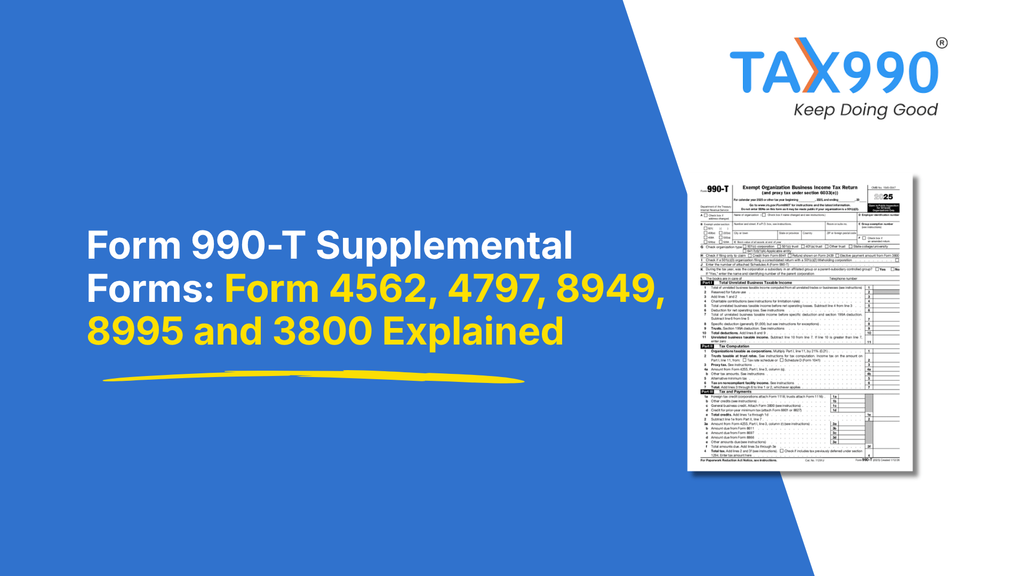
An organization with $1,000 or more in gross income from an unrelated trade or business must file Form 990-T, Exempt Organization Business Income Tax Return. But Form 990-T rarely stands alone. Depending on the nature of the unrelated business activity, an organization may need to attach one or more supplemental forms to properly calculate income, deductions, and credits.
For finance teams and tax preparers working through a 990-T filing, knowing which of these forms applies makes the difference between a return that’s complete on the first pass and one that comes back with questions from the IRS. Here’s a look at five of the most common supplemental forms: Form 4562, Form 4797, Form 8949, Form 8995, and Form 3800.
Form 4562: Depreciation and Amortization
If the unrelated trade or business uses depreciable assets (equipment, vehicles, furniture, or property placed in service for that activity) the organization claims the related deduction on Form 4562. This includes standard depreciation, Section 179 expensing, and amortization of certain intangible costs.
Form 4562 attaches to Schedule A (Form 990-T) whenever a depreciation deduction is claimed against unrelated business income. The depreciation calculated on Form 4562 flows to the deductions section of Schedule A, reducing unrelated business taxable income (UBTI) for that trade or business.
Form 4797: Sales of Business Property
When an organization sells, exchanges, or otherwise disposes of property used in its unrelated trade or business (equipment, real property, or other business assets) that transaction is reported on Form 4797.
Form 4797 does the work of sorting the transaction into the correct tax treatment. Gain attributable to depreciation the organization already deducted is generally recaptured as ordinary income. The remaining gain, for property held in connection with a debt-financed investment or, in certain cases, an interest in a Qualified Opportunity Fund. Each transaction is listed individually, with the resulting totals carried to the capital gains section of Schedule A (Form 990-T).
This form gives the IRS a transaction-level record, which is why accuracy on cost basis and holding period matters here in particular. Errors on Form 8949 tend to surface as mismatches during IRS review.
Form 8995: Qualified Business Income Deduction Simplified Computation
Form 8995 applies in a narrower set of circumstances than the others on this list. It’s used by trusts filing Form 990-T that have unrelated business income potentially eligible for the qualified business income (QBI) deduction under Section 199 A. The form walks through whether the trust has qualified business income and, if so, calculates the deduction generally up to 20% of that income.
Because the QBI deduction under Section 199A is available to trusts but not to corporations, Form 8995 is relevant only to organizations filing Form 990-T as a trust.
Form 3800: General Business Credit
Form 3800 consolidates more than 30 individual federal business tax credits into a single calculation. If the unrelated business activity generates a credit-eligible expense, the organization completes the relevant credit form first, then carries that amount into Form 3800.
The total allowable credit from 3800 is reported on Schedule A (Form 990-T), Part II, and ultimately reduces the tax due on Form 990-T, Part III, line 6g. Any credit that can’t be used in the current year may generally be carried back one year or forward up to 20 years, subject to IRS rules.
Filing With the Right Forms Attached
Each of these forms exists to support a specific piece of the UBTI calculation – depreciation, property sales, capital transactions, the QBI deduction, or credits. An organization won’t necessarily need all five in a given year; which ones apply depends entirely on the unrelated business activity itself.
Interested in learning more about the supplemental forms Tax990 offers? Find more information here.

Leave a Comment