

Unrelated Business Income: The Three-Prong Test Nonprofits Miss
Estimated reading time: 16 minute(s)
Unrelated business income is revenue your organization earns from a trade or business that’s regularly carried on and isn’t substantially related to its exempt purpose. Tax-exempt status doesn’t cover it. If your organization sells something, rents something out, or runs an activity on the side that brings in money, part of that revenue may be taxable at the corporate rate, and it gets reported on Form 990-T.
It’s one of the most commonly missed areas of nonprofit compliance, and most organizations don’t learn the rule applies to them until a return is already late.
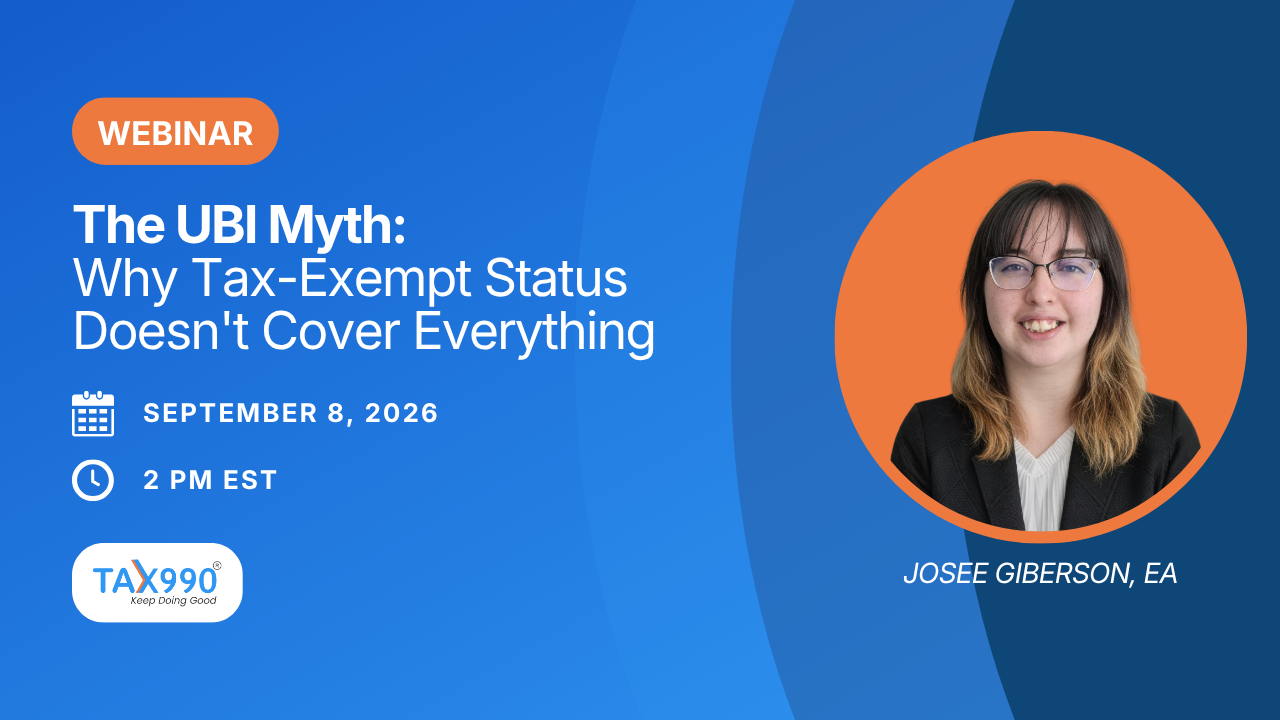
On September 8, Tax Analyst Josee Giberson, EA, walked through the test the IRS uses to identify unrelated business income, the exceptions that trip people up, and how it all lands on Form 990-T. Here’s what you can put to work right away.
Watch the full session
The complete recording, including both worked examples and the live Q&A, is available to registered attendees. Watch The UBI Myth webinar recording.
What Counts as Unrelated Business Income?
The IRS applies a three-prong test. An activity has to meet all three conditions to count. Miss any one, and it doesn’t count.
- Is it a trade or business? There’s an intent to generate revenue and an exchange of goods or services. Activities without a profit motive, things sold well below fair value, and hobbies don’t qualify.
- Is it regularly carried on? This gets misread often, including by tax professionals. The question isn’t whether your activity runs on a regular schedule. It’s whether it runs as often as a comparable for-profit business doing the same thing would.
- Is it substantially related to your exempt purpose? The activity has to contribute to the exempt purpose, not simply fund it.
That third prong catches people. Raising money for your mission and furthering it aren’t the same thing to the IRS, and revenue that supports good work can still be taxable. The IRS covers the general rule in its guidance on unrelated business income tax, and the statutory definitions sit in IRC Section 512.
Josee covers all this in more depth in the webinar.
Where Organizations Get Tripped Up
Josee also walked through two cases that look alike and land in different places. One is a school selling wrapping paper each winter to fund a spring field trip. The other is an organization renting out a parking lot it didn’t need, seven days a week, to pay for educational materials. Both raise money for the mission, and both sell at ordinary market prices. Only one is unrelated business income, and the deciding factor isn’t the one most people guess.
See how the examples resolve
Josee works through both cases prong by prong in the recording. Watch the full webinar.
Which Activities Are Exempt?
Sometimes an activity meets all three prongs and still isn’t taxable. And sometimes an exclusion gets pulled back in. Here’s how the common pairs line up.
| Usually excluded | But taxable anyway when |
|---|---|
| Passive investment income | You used debt to acquire the asset |
| Sponsorship acknowledged with a thank-you and a logo | The sponsor asks you to promote its product or service, which makes it advertising |
| Member communications without advertising | The publication is a periodical, where even a logo counts |
| Activities where unpaid volunteers do more than 85 percent of the work | Paid staff carry most of the activity |
| Activities for the convenience of members | The activity is open to the general public |
| Sales of substantially donated merchandise, and many bingo games | The merchandise was purchased rather than donated |
Debt-financed income deserves its own note. If you used debt to buy an income-generating asset, the debt-financed portion can pull an otherwise-excluded activity back in. Divide the average debt over the tax year by the adjusted basis for the same period.
How Do You File Form 990-T?
Form 990-T is due the 15th day of the fifth month after your tax year ends. For calendar-year filers that’s May 15. You can extend with Form 8868, but you need a separate extension for your 990 series return and your Form 990-T.
Two requirements are easy to overlook. Form 990-T is open to public disclosure, so your organization has to provide a copy on request, and if you expect to owe more than $500 you’re required to make estimated payments during the tax year. IRAs filing Form 990-T run on a calendar year, with an April 15 deadline extendable to October 15.
The main form runs two pages and mostly handles the tax calculation. The work sits in Schedule A, where each activity is reported separately. Activities are siloed, so deductions and losses from one don’t offset another, and shared expenses are allocated by actual use. Our guide to Form 990-T’s Schedule A breaks that down, and the supplemental forms explainer covers what attaches to it.
One deduction applies across everything. Form 990-T carries a $1,000 specific deduction against total unrelated business income, not against each activity. That’s why Form 990, Form 990-EZ, and Form 990-PF ask whether you have more than $1,000 of it. Below that threshold, there’s nothing to file.
What Happens if You Don’t File?
Filing late carries a penalty of 5 percent of the tax due per month or part of a month, with a $525 minimum and a 25 percent maximum. Failing to pay adds interest plus a penalty of half a percent to 1 percent of the tax due, also capped at 25 percent.
The one worth particular attention is the trust fund recovery penalty, assessed against the individual responsible for filing and paying on the organization’s behalf rather than the organization itself. Consistent failure to file can also put your tax-exempt status at risk. For background, start with our overview of Form 990-T.
Get the full recording
For both examples end to end, a reporting walkthrough for an organization with two unrelated activities, a live Q&A, and more watch The UBI Myth webinar recording, and see the upcoming Tax990 webinar schedule for what’s next.
This recap is general information, not tax advice for your organization’s specific circumstances. For questions about your situation, contact a qualified tax professional or email [email protected].

Leave a Comment