Sports Clubs and Tax-Exemption: 501(c)(3) Eligibility and Requirements
Estimated reading time: 25 minute(s)
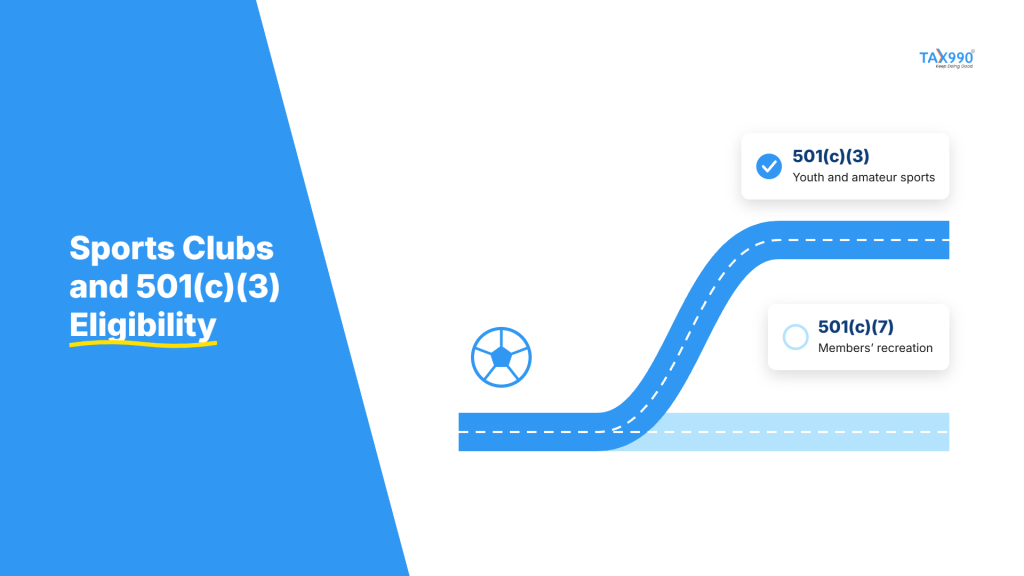
A sports club can qualify for 501(c)(3) tax-exempt status when it operates for the benefit of the public, most commonly by serving youth athletes or organizing amateur competition, rather than for its own members’ recreational benefit.
What Is a Sports Club?
A sports club is an organization formed by a group of members exclusively to support sporting activities. That can mean a single sport or several, and clubs are typically organized around sport type, age group, or geography, from a citywide youth soccer league to a regional amateur swimming association.
The IRS doesn’t treat “sports club” as one tax category, though. Where your organization lands depends on who it’s actually organized to benefit.
Is Your Sports Club a 501(c)(3) or a 501(c)(7)?
This is the question the old version of this guide skipped, and it trips up a lot of organizations before they ever file a determination letter application.
If your club exists mainly for its own members’ enjoyment, think of an adult recreational league or a club built around a shared hobby, it’s generally organized to benefit its members rather than the public. That points to 501(c)(7) social and recreational club status, not 501(c)(3). Under 501(c)(7), the organization is typically funded by membership dues, and members can’t deduct those dues as charitable contributions. Tax990’s guide to social and recreation club filing covers those rules in full if that sounds like your organization.
501(c)(3) status is reserved for organizations that operate for the benefit of the public or the community, most commonly youth sports programs and amateur athletic competition, rather than for the private recreational benefit of their own members. If donors are giving to your organization and expecting a charitable deduction, or if your mission is genuinely about serving young athletes or the broader sporting community, 501(c)(3) is the right lane. If your club is really a members-only recreational group, 501(c)(7) is worth exploring instead, and it comes with its own separate compliance rules. For a broader look at how 501(c)(3) compares to other classifications, see Tax990’s 501(c)(3) vs. other 501(c) and 509 classifications guide.
The rest of this guide focuses on organizations pursuing 501(c)(3) status, since that’s where most youth and amateur sports organizations belong.
How Sports Clubs Qualify for 501(c)(3) Tax-Exempt Status
Under IRC 501(c)(3) and IRS Revenue Ruling 80-215, a sports club can qualify for tax-exempt status through a few different paths. For the full mechanics of qualifying, Tax990’s complete guide to 501(c)(3) tax-exempt status is a good companion to this section.
Charitable purpose. Organizations that promote a sport among youth, generally under 18, through organized teams and local or state competition can qualify as charitable. This also covers programs aimed at combating juvenile delinquency by giving young people a structured, supervised activity.
Educational purpose. Clubs that run free sports clinics with qualified instructors, and that provide the equipment needed for that instruction, can qualify under the educational purpose test.
Organizing amateur sports competitions. The law also recognizes exempt organizations formed to organize and support national or international amateur sports competition. This path comes with an important restriction: if the organization serves adults under this purpose rather than youth, it generally cannot also provide athletic facilities or equipment. The organization needs to stay focused on organizing and supporting competition itself, not operating recreational facilities. That restriction doesn’t apply when the organization is serving youth through the charitable or educational paths above, so a youth clinic that hands out equipment is on solid ground.
Whichever path applies, every 501(c)(3) organization also has to meet the baseline requirements that apply across the board: operating exclusively for exempt purposes, making sure no private individual profits from the organization’s activities, keeping lobbying activity limited, and staying out of political campaigns entirely.
How to Apply for Tax-Exempt Status
Once you’ve confirmed your club’s purpose fits 501(c)(3), the next step is applying for recognition of exemption.
Most organizations file Form 1023, the standard application, electronically through Pay.gov.
Smaller organizations may qualify for Form 1023-EZ, the streamlined version. To use it, your organization can’t project annual gross receipts over $50,000 in any of the next three years, and it can’t have exceeded $50,000 in gross receipts in any of the past three years either. Total assets also need to stay at or under $250,000 in fair market value. Answer “yes” to either threshold question on the IRS eligibility worksheet, and you’ll need to file the full Form 1023 instead.
Once the IRS approves the application, your organization receives a determination letter confirming its tax-exempt status, along with confirmation of its EIN.
Annual Filing Requirements for Sports Clubs
Tax exemption isn’t a one-time event. Every exempt organization has an annual filing obligation, and which form applies depends on gross receipts and total assets.
| Form | Who Files It |
| Form 990-N (e-Postcard) | Gross receipts of $50,000 or less |
| Form 990-EZ | Gross receipts under $200,000 and total assets under $500,000 |
| Form 990 | Gross receipts of $200,000 or more, or total assets of $500,000 or more |
| Form 990-PF | Organizations structured or funded as a private foundation |
| Form 990-T | Any organization with $1,000 or more in unrelated business income |
Does Your Sports Club Owe Tax on Concessions or Merchandise Sales?
Unrelated business income is income from an activity not substantially related to the organization’s exempt purpose, and it’s the row in the table above that catches a lot of sports clubs by surprise. Concessions and merchandise sales at games and tournaments are common sources of it. Once that income reaches $1,000, Form 990-T is required regardless of which other 990 form the organization files. It’s worth checking concession and merchandise revenue against that threshold every season, not just at tax time.
Don’t Forget State-Level Requirements
Federal exemption and Form 990 cover your IRS obligations, but most states layer on their own requirements too. Many require a separate charitable solicitation registration before your club can legally fundraise, plus a state-level annual report. Exact rules vary by state, so check with your state’s charity regulator or attorney general’s office in addition to filing with the IRS.
For a full walkthrough of the federal thresholds, along with the club-specific details in this guide, see Tax990’s nonprofit sports club filing overview.
Filing Deadlines and Penalties for Late Filing
Form 990, in whichever version applies to your organization, is due on the 15th day of the fifth month after your organization’s accounting period ends. For calendar-year filers, that’s May 15. Need more time? Form 8868 gives most organizations an automatic six-month extension. Tax990’s Form 990 deadlines guide has a full breakdown by fiscal year.
Missing that deadline carries a real cost, per current IRS penalty guidance. Organizations with gross receipts under $1,208,500 face a penalty of $20 per day the return is late, up to the lesser of $12,000 or 5 percent of the organization’s gross receipts. Organizations at or above that $1,208,500 threshold face $120 per day, up to a maximum of $60,000.
What Happens After Three Years of Not Filing?
The dollar penalty isn’t the biggest risk. Fail to file for three consecutive years, on any version of Form 990, and the IRS automatically revokes the organization’s tax-exempt status. Rebuilding from there means reapplying for exemption from scratch, which can take months and puts every program your club runs on hold in the meantime. Filing on time, every year, is what protects your organization’s ability to keep serving the athletes and communities it was built for.
Key Takeaways
- Confirm your club serves the public, not just its own members, before pursuing 501(c)(3) rather than 501(c)(7).
- Apply with Form 1023, or Form 1023-EZ if gross receipts stay under $50,000 and assets under $250,000.
- File the right annual form based on gross receipts and assets, and watch for unrelated business income from concessions or merchandise.
- Mark May 15 (or your fiscal-year equivalent) on the calendar, and file Form 8868 early if you need more time.
- Three consecutive years of missed filings means automatic revocation, not just a penalty.
File With Confidence Using Tax990
Tax990 is built specifically for nonprofit filers, including sports clubs navigating exactly these thresholds. The platform supports the full range of forms your organization might need, Form 990-N, 990-EZ, 990, 990-PF, and 990-T, with built-in IRS business rules that catch errors before your return is transmitted. A multi-user review workflow lets your treasurer prepare the return and your board sign off before it goes to the IRS, which matters for organizations that answer to a governing body.
Every return filed through Tax990 is backed by the Tax990 Commitment: IRS acceptance or your money back, up to three free amendments and retransmissions if something needs correcting, and extension filing with Form 8868 included at no additional cost. Filing is also covered by Protection Plus, which provides up to $1 million in professional audit defense, automatically and at no extra charge, for up to three years after the IRS accepts your return. If the IRS follows up, representation from enrolled agents, CPAs, and attorneys is already in place.
Ready to file?
Create your free Tax990 account to get started, or see transparent Form 990 pricing for your organization’s filing needs.