
- Posted inin General
- Nonprofits
Closing or Merging a Nonprofit: Your Final Form 990
- Posted byPatience Booker
- 0 Comments
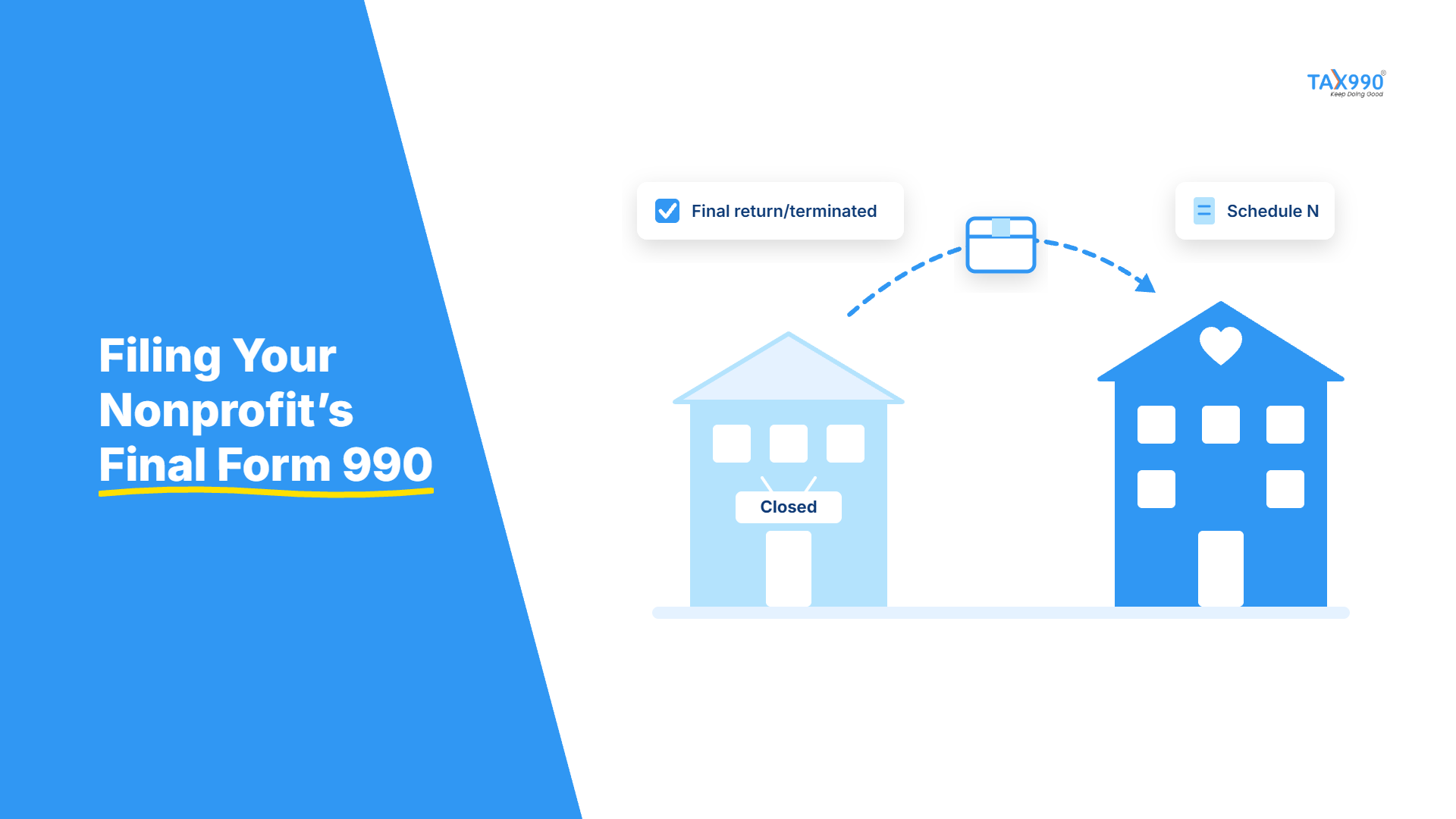
Closing a nonprofit’s doors is rarely a single decision. It’s a sequence of filings, and the last one you’ll ever submit for that organization has to get several things right at once. A nonprofit’s final Form 990 needs to check the terminated box, attach Schedule N describing where its assets went, and show that any remaining funds went to another tax-exempt organization, not to individuals or a for-profit venture. Get any of that wrong, and there’s no one left to file a correction once the organization no longer exists.
Dissolution or Merger: Decide Which One You’re Doing First
Before anything else, separate the two situations, because they lead to different filings and different responsibilities.
Dissolution means the organization is winding down entirely. Its programs end, its assets are distributed, and it ceases to exist as a legal entity. The organization itself is responsible for its final return and for every state-side step involved in shutting down.
Merger means the organization is combining with or being absorbed into another organization. One entity typically survives and continues operating, while the other stops filing under its own EIN. The final filing obligation still exists, but who handles it and what happens to the entity’s tax identity look different from a straight dissolution.
Getting this distinction right up front determines who signs the final return, which organization’s EIN is involved, and which set of state notifications applies.
| Dissolution | Merger | |
| Who files the final return | The dissolving organization itself | The organization being absorbed (or its last officers) |
| What happens to the EIN | Retired once the final return is filed | Typically retired for the absorbed organization; the surviving organization keeps its own EIN |
| State notifications | Articles of dissolution, charity regulator, charitable solicitation registration | Often similar, but requirements vary by state and merger structure |
| New determination letter needed | No — the organization is ending, not continuing | Sometimes, if the merger substantially changes structure or purpose |
Your Closing Checklist: Federal and State Steps at a Glance
Here’s the sequence, in order:
- Get board or member approval to dissolve or merge, as your bylaws require.
- Settle debts and finalize creditor obligations before distributing anything.
- Distribute remaining assets to another tax-exempt organization, per your organizing documents.
- File your final Form 990, 990-EZ, or 990-PF with the terminated box checked.
- Attach Schedule N, documenting where the assets went and to whom.
- File articles of dissolution with your state’s secretary of state (or equivalent office).
- Notify your state’s charity regulator and close out any charitable solicitation registration.
The sections below walk through the steps most organizations get wrong.
Before You Distribute Anything: Board Approval and Settling Debts
Dissolution isn’t something staff can decide alone. Most state nonprofit laws, and virtually every set of bylaws, require formal board approval, and many also require a vote of the organization’s members if it has a voting membership structure. That approval should be documented in board minutes, since it’s part of what Schedule N later asks you to describe.
Debts come next, before any asset distribution. Outstanding vendor invoices, lease obligations, and staff final pay all need to be settled first. Distributing assets to a successor organization while creditors are still owed money can create personal liability for board members in some states, which is exactly the kind of mistake that’s difficult to unwind once the organization has stopped operating.
The Final Return Checkbox That Gets Missed
The Final Return/Terminated box sits in the header of page 1 of Form 990 and Form 990-EZ; Form 990-PF filers check a similarly labeled Final Return box in a different header location. According to the IRS’s guidance on terminating an exempt organization, checking it applies once the organization is ceasing all activities, and it typically requires attaching Schedule N to describe the assets distributed, their fair market value, transaction fees, the date of distribution, and information about the recipients.
Organizations forget to check it for a simple reason: by the time the final return is due, the people who oversaw the dissolution or merger have often moved on, and whoever prepares the return doesn’t know to flag it as final. The return gets filed the same way it always has, and the IRS has no reason to know the organization is gone. That can leave the organization technically active in IRS records long after it stopped operating.
If you’re closing out the short form, Tax990’s guide to filing a final 990-EZ return after termination walks through the specifics. Private foundations should see the final Form 990-PF filing guide instead.
Where the Remaining Assets Are Allowed to Go
For a 501(c)(3), what happens to leftover assets isn’t a board decision. It’s a legal requirement baked into the organization’s own founding documents. To qualify for tax-exempt status in the first place, a 501(c)(3)’s articles of incorporation have to include a dissolution clause stating that any remaining assets, after debts and liabilities are settled, will go to another tax-exempt organization for an exempt purpose.
That means remaining funds cannot go to board members, staff, or any individual, no matter how involved they were in the organization’s work. They also cannot be transferred to a for-profit venture, even one founded by the same people to carry the mission forward informally. Schedule N asks organizations to report exactly where assets went, so this isn’t a step that can be handled quietly. If the organizing documents don’t already specify a recipient, the board needs to choose one that qualifies before assets move anywhere. Tax990’s guide to navigating the 990 series and its schedules covers how Schedule N fits alongside the return’s other required attachments.
The State-Side Steps in Detail
A final Form 990 satisfies the federal side, but dissolving a nonprofit also means closing things out at the state level. Most states require articles of dissolution to be filed with the secretary of state or equivalent office, formally ending the organization’s legal existence as a corporate entity. Separately, the state’s charity regulator, often the attorney general’s office, typically needs to be notified as part of its oversight of charitable assets.
Finally, if the organization registered to solicit donations in any state, that charitable solicitation registration needs to be formally closed out rather than left to lapse. Skipping this step can generate compliance notices for an organization that no longer exists to respond to them.
Do You Need a New EIN If Your Nonprofit Merges?
In most cases, no. The surviving organization typically keeps its own EIN, and the absorbed organization’s EIN is retired rather than carried forward. Whether the surviving organization needs a new determination letter depends on how much the merger changes its structure or purpose. A merger that substantially alters the organization’s activities or governance may prompt the IRS to expect updated information, while a straightforward absorption often doesn’t require a new exemption application.
This is a narrower area than the rest of this article: the EIN and determination-letter questions for nonprofit mergers aren’t laid out cleanly on a single IRS.gov page the way the termination checkbox and Schedule N are, and they can turn on details specific to the merger’s legal structure. Organizations working through a merger should confirm these two points with legal counsel rather than treat this section as a final answer.
Responsibility for the final filing of the organization being absorbed doesn’t automatically transfer. Someone from that organization, typically its last board or an officer with signing authority, needs to ensure its final return gets filed correctly and marked as final before the merger closes it out. Assuming the surviving organization will handle it, without confirming that explicitly, is how this step gets missed.
Getting the Last Return Right the First Time
A final Form 990 doesn’t get a second chance the way an ordinary year’s return might. There’s no board left to authorize an amendment and no staff left to track down missing records once the organization has closed. That makes accuracy on this specific return more important, not less, than the returns that came before it.
Tax990 supports the full 990 series, including final returns with Schedule N, with a guided workflow built to catch the details organizations closing out tend to miss. Every return is backed by the Tax990 Commitment, and Protection Plus audit defense is included automatically at no additional cost, so the organization’s last filing is backed the same way every other one was.
Create your free Tax990 account to file your final return, or contact our support team if your dissolution or merger raises questions specific to your organization.
Recent Posts
- Choosing a Form 990 E-File Provider: What to Compare Beyond Price
- Is Your Organization a Public Charity? Why Form 990 Schedule A Matters Under the New Scholarship Tax Credit
- Section 25F Scholarship Tax Credit: What 501(c)(3) Organizations Need to Know Before 2027
- Form 15644, Explained: What Group Exemption Numbers Need to File
- Nonprofit Board Meeting Agenda Best Practices: Stop Wasting Board Time