

- Posted inin General
- Quick Guide
Form 15644, Explained: What Group Exemption Numbers Need to File
- Posted byPatience Booker
- 0 Comments
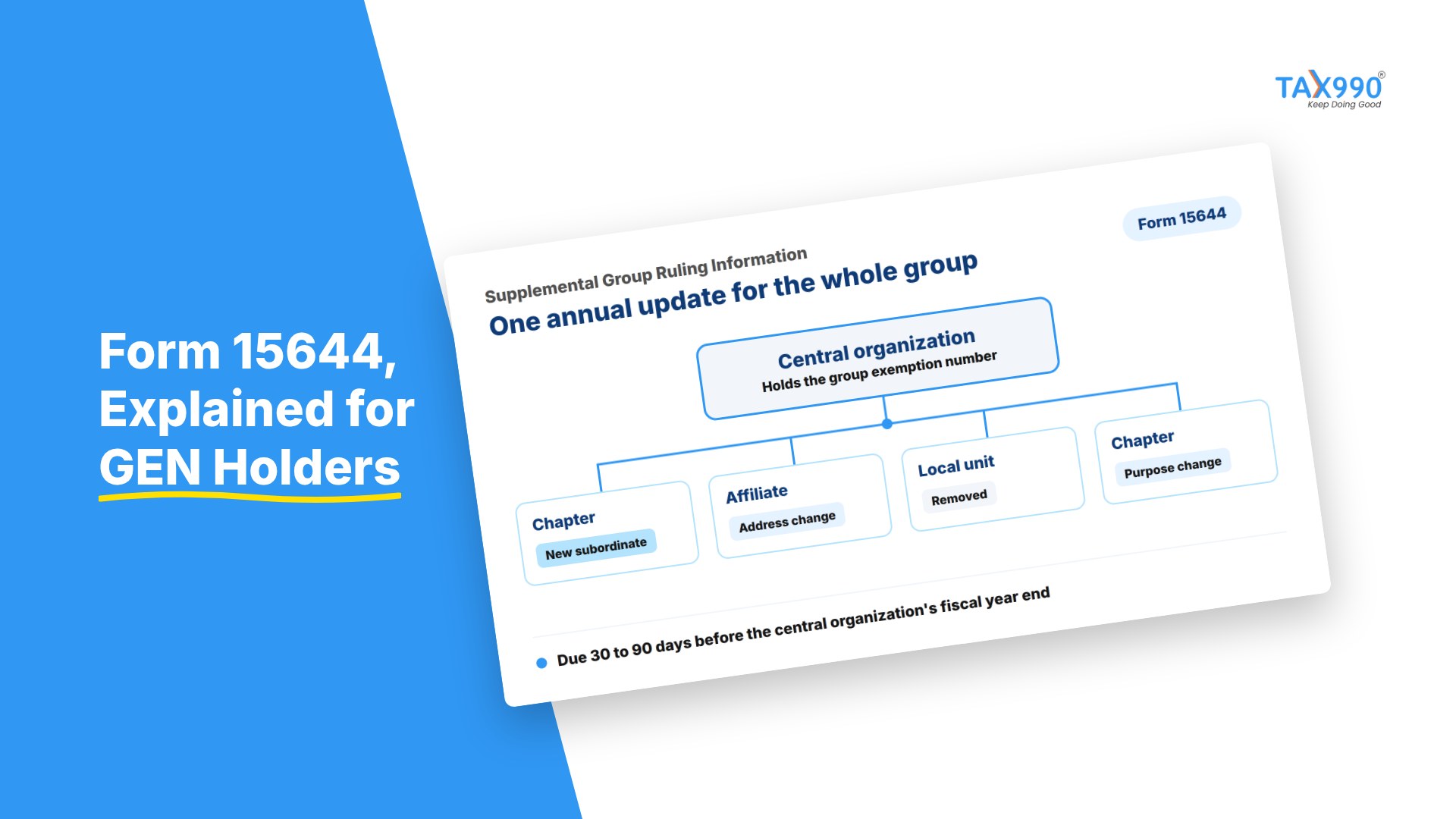
If your organization holds a group exemption number (GEN) for its chapters, affiliates, or local units, the IRS now has a set form for your yearly update. Form 15644 is the IRS form a central organization uses to submit its annual Supplemental Group Ruling Information (SGRI), which keeps its group exemption letter in good standing. Below is what the form covers, when it’s due, and what the rest of your group still needs to file.
What Is Form 15644?
Form 15644, Supplemental Group Ruling Information, is the form central organizations use to report changes to their subordinate organizations each year. The IRS announced it in its July 14, 2026 Exempt Organizations Update. It carries out section 7 of Revenue Procedure 2026-8, which took effect January 20, 2026.
Before this, central organizations sent SGRI as a letter under Rev. Proc. 80-27. A standard form removes the guesswork about what the IRS expects to see. If you’re newer to how group exemptions work, start with our overview of the IRS’s new group exemption rules.
A group exemption number is the four-digit number the IRS assigns to a central organization’s group exemption letter. Subordinates covered by the letter use it to show their tax-exempt status without applying on their own.
Central Organization Filing Requirements for Form 15644
Most central organizations that hold a group exemption letter must file Form 15644 every year. Churches, and conventions or associations of churches described in section 501(c)(3), can file it if they choose but aren’t required to.
The central organization files one form for the whole group. Subordinate organizations don’t file Form 15644 themselves.
When Is Form 15644 Due?
Submit Form 15644 at least 30 days, but no more than 90 days, before the end of the central organization’s annual accounting period.
| Fiscal year ending | Window opens | Window closes |
|---|---|---|
| December 31 | October 2 | December 1 |
| June 30 | April 1 | May 31 |
| September 30 | July 2 | August 31 |
[Visual: a timeline graphic showing the filing window before fiscal year end. Alt text: “Form 15644 filing window 30 to 90 days before fiscal year end.”]
For calendar-year central organizations, the first window opens October 2, 2026. You can also send Form 15644 at any other time of year to add or remove a subordinate, so there’s no need to hold changes for the annual update.
What Does Form 15644 Report?
Form 15644 gives the IRS a current picture of your group. You’ll use it to report:
- Changes to existing subordinates: new names or mailing addresses
- Subordinates leaving the group: organizations that were removed, stopped operating, or had their status automatically revoked
- New subordinates: name, mailing address, and EIN for each, plus confirmation that each one gave written authorization to be included
- Changes in purpose or operations: any change to a subordinate’s purpose, character, or method of operation
- Group-wide attestations: confirmation that all subordinates fall under the same paragraph of section 501(c) and share a uniform purpose statement where required
- Termination: a request to end the group exemption letter
For now, the IRS accepts Form 15644 only by fax, at 833-312-5228. Keep your fax confirmation with your records.
What Happens If You Miss the Filing Window?
The IRS may terminate a group exemption letter if a central organization (other than a church) doesn’t submit timely and complete SGRI. Every subordinate that relies on your GEN would then lose that coverage.
Groups that existed before January 20, 2026, have a transition period through January 22, 2027. During it, some new requirements don’t apply yet, including the five-subordinate minimum and the same-paragraph rule. The annual SGRI requirement isn’t on that list, so plan to file in your first window.
Beyond Form 15644: What Else GEN Holders File
Form 15644 keeps your group exemption letter current. It doesn’t replace anyone’s annual return.
| Filing | Who files | Notes |
| Form 990, 990-EZ, or 990-N | The central organization | For its own activity |
| Form 990, 990-EZ, or 990-N | Each subordinate | Unless the subordinate is included in a group return |
| Form 990 group return | The central organization, for its subordinates | Separate from the central organization’s own return |
| Form 8868 | Any filer that needs more time | Extends the annual return deadline |
Smaller chapters with gross receipts of $50,000 or less can usually file Form 990-N, the e-Postcard. Subordinates on a group return must share the central organization’s annual accounting period. If you aren’t sure which classification your chapters fall under, our guide to 501(c)(3) and other 501(c) classifications explains the differences. To confirm what your group letter says, see how to read your IRS determination letter.
Keeping track of dozens or hundreds of chapter returns is where most central organizations get stuck. Tax990’s multi-unit filing solution for central organizations lets you manage returns for every subordinate from a single account, whether they file separately or on a group return.
Form 15644 FAQs
Do Churches Have to File Form 15644?
No. Churches and conventions or associations of churches described in section 501(c)(3) can submit Form 15644 but aren’t required to.
Can You E-File Form 15644?
Not yet. The IRS currently accepts Form 15644 only by fax, at 833-312-5228.
Is Form 15644 Required During the Transition Period?
Yes. The transition relief in Rev. Proc. 2026-8 covers certain rules about how groups are structured. It doesn’t cover the annual SGRI requirement, so file in your first window.
Keep Your Whole Group Compliant
A current Form 15644 protects every chapter that relies on your GEN. Accurate annual returns do the same for each chapter. Tax990 supports the full 990 series with a guided workflow, and every return is backed by the Tax990 Commitment. That means IRS acceptance or your money back, free amendments, and free retransmissions. Protection Plus audit defense is included automatically at no additional cost.
Schedule a Tax990 demo for your group or explore multi-unit filing for GEN holders.
Recent Posts
- Form 15644, Explained: What Group Exemption Numbers Need to File
- Nonprofit Board Meeting Agenda Best Practices: Stop Wasting Board Time
- Nonprofit Revenue Types and the Tax Rules Behind Each One
- Closing or Merging a Nonprofit: Your Final Form 990
- Unrelated Business Income: The Three-Prong Test Nonprofits Miss