
- Posted inin Form 990
Group Exemption Numbers and Form 990: Filing Requirements for Subordinate Organizations
- Posted byPatience Booker
- 0 Comments
If your chapter, parish, post, or local affiliate operates under a central organization’s group exemption, you may never have filed your own exemption application. Annual reporting is a separate obligation, and it still applies to most subordinates. Here’s how your group exemption number connects to Form 990.
What Is a Group Exemption Number?
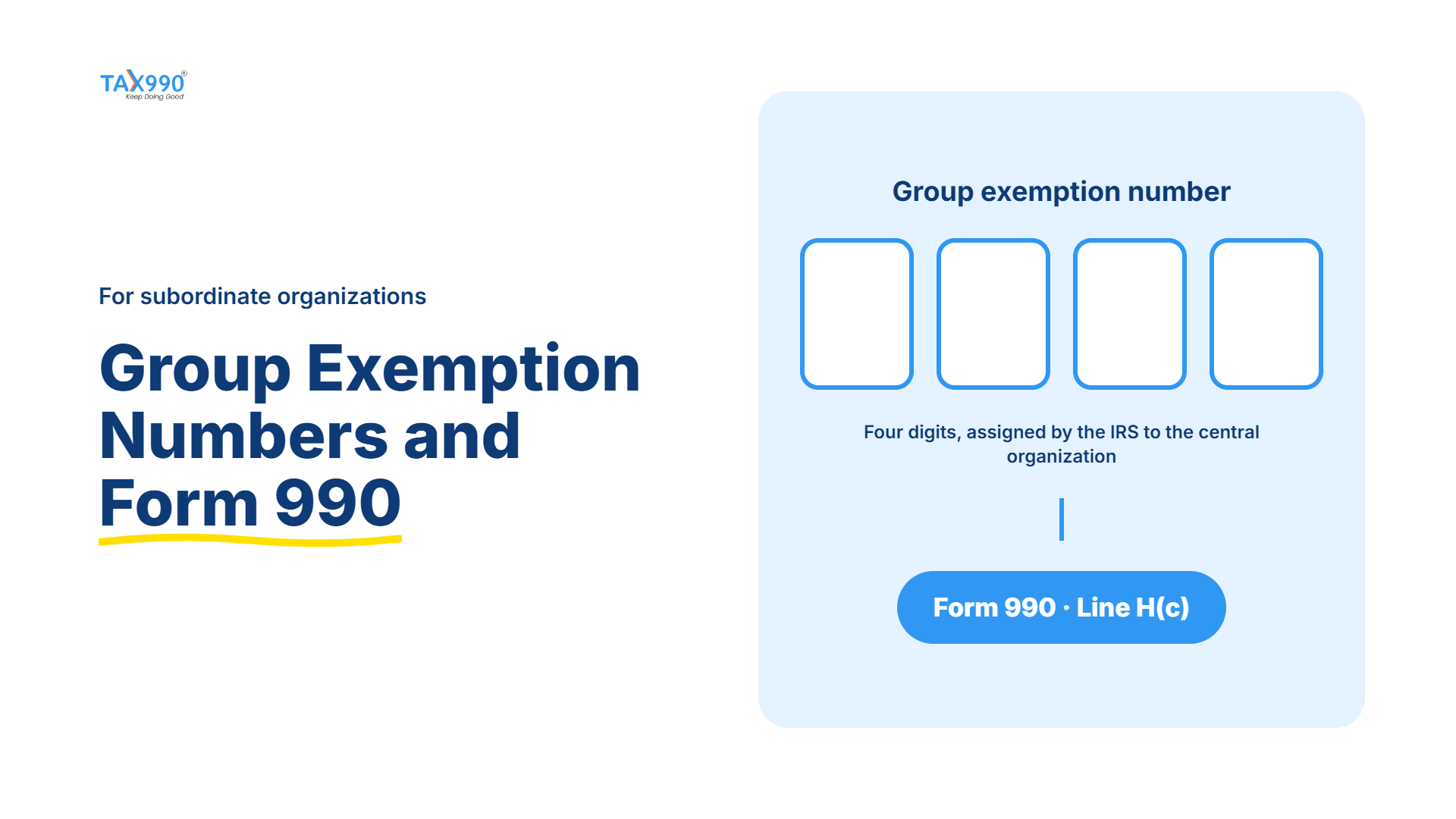
A group exemption number (GEN) is a four-digit number the IRS assigns to a central organization’s group exemption letter, which recognizes the tax-exempt status of the subordinate organizations under that central organization’s general supervision or control. Each subordinate keeps its own EIN but shares the central organization’s GEN.
One GEN can cover a handful of local chapters or thousands of organizations. GEN 0928, held by the United States Conference of Catholic Bishops, covers organizations listed in the Official Catholic Directory, and more than 1,300 of them file a 990-series return.
The IRS doesn’t publish a single list of every GEN, so check your group exemption letter or ask your central organization. The IRS Exempt Organizations Business Master File also lists the GEN for each organization that has one. Our guide to reading your IRS determination letter can help.
What Rev. Proc. 2026-8 Changed for Subordinates
The IRS modernized its group exemption procedures in Rev. Proc. 2026-8, effective January 20, 2026. The points that matter most to subordinates:
- Group size. A central organization needs at least five subordinates to obtain a group exemption letter and at least one to keep it.
- Matching classification. All subordinates must be described in the same 501(c) paragraph, such as 501(c)(3).
- Shared accounting period. Subordinates included in a group return must use the same tax year as the central organization.
- Collective risk. The IRS can terminate the entire group exemption if more than half of the subordinates are automatically revoked.
Preexisting group letters have a transition period through January 22, 2027. Read what nonprofits need to know about the IRS’s new group exemption rules for the full breakdown, and see our Form 15644 guide for the annual update central organizations now submit.
Do Subordinate Organizations Have to File Form 990?
Yes, in most cases. Being covered by a group exemption letter satisfies the exemption application, but each subordinate still has an annual filing requirement it can meet in one of two ways:
- Be included in the central organization’s group return on Form 990.
- File its own 990-series return and enter the central organization’s GEN.
Churches, their integrated auxiliaries, and conventions or associations of churches aren’t required to file Form 990. Religious groups often include subordinates that aren’t churches, such as counseling ministries or social service programs, and those generally do have a filing requirement.
How a Form 990 Group Return Works
According to the Form 990 instructions, a central organization can file a group return on Form 990 for two or more subordinates that are:
- Affiliated with the central organization at the end of its tax year
- Subject to the central organization’s general supervision or control
- Exempt under a group exemption letter that’s still in effect
- Using the same tax year as the central organization
The central organization can’t use Form 990-EZ for a group return. If the central organization has its own filing requirement, it files a separate return and can’t include itself in the group return. Every year, each subordinate must authorize its inclusion in writing and declare, under penalties of perjury, that the information it submits is true and complete.
| Included in the group return | Files its own return | |
| Who files | Central organization | Subordinate |
| Form used | Form 990 only | Form 990-N, 990-EZ, or 990 |
| Annual authorization | Written authorization required each year | Not required |
| GEN reported | On the group return | On the subordinate’s own return |
| Separate e-Postcard | Not filed | Filed if it qualifies |
Which Return Does a Subordinate Filing Separately Use?
A subordinate that files on its own chooses the form based on its size, using the same thresholds as any other organization.
| Form | Who can use it |
| Form 990-N (e-Postcard) | Gross receipts normally $50,000 or less |
| Form 990-EZ | Gross receipts under $200,000 and total assets under $500,000 |
| Form 990 | Gross receipts of $200,000 or more, or total assets of $500,000 or more |
Smaller chapters and local units often qualify for Form 990-N. A subordinate included in a group return doesn’t file Form 990-N for that year, because the group return satisfies its annual reporting requirement.
Where Does the Group Exemption Number Go on Form 990?
Form 990 asks for the GEN in the heading on line H(c). Form 990-EZ asks for it on line F of the heading. Enter it exactly as it appears on the group exemption letter.
What Happens If a Subordinate Doesn’t File?
An organization that fails to file a required return for three consecutive years loses its tax-exempt status automatically under IRC Section 6033(j). Subordinates are no exception. Under Rev. Proc. 2026-8, an automatically revoked subordinate can be removed from the group, and widespread revocations can put the group exemption itself at risk.
Returns are due on the 15th day of the fifth month after the tax year ends. Review the Form 990 filing due date for your fiscal year, and if you need more time, e-file Form 8868 for an automatic six-month extension.
File for Every Organization in Your Group With Tax990
Whether you’re a central organization coordinating dozens of subordinates or a single chapter filing on its own, Tax990 supports Form 990, 990-EZ, 990-N, and 8868 with a guided workflow and built-in error checks. Every return is backed by the Tax990 Commitment: IRS acceptance or your money back, plus free amendments and retransmissions. Protection Plus audit defense is included automatically at no additional cost.
Managing returns for multiple subordinates?
Explore Tax990 for multi-unit filers or request a demo for your group.
Recent Posts
- Group Exemption Numbers and Form 990: Filing Requirements for Subordinate Organizations
- Understanding the 990-N Form: A Guide for Small Nonprofits
- Introducing 990-N Full Service: Our Experts Will File Your Form 990-N for You
- Choosing a Form 990 E-File Provider: What to Compare Beyond Price
- Is Your Organization a Public Charity? Why Form 990 Schedule A Matters Under the New Scholarship Tax Credit