- Posted inin Nonprofits
Is Your Organization a Public Charity? Why Form 990 Schedule A Matters Under the New Scholarship Tax Credit
- Posted byPatience Booker
- 0 Comments
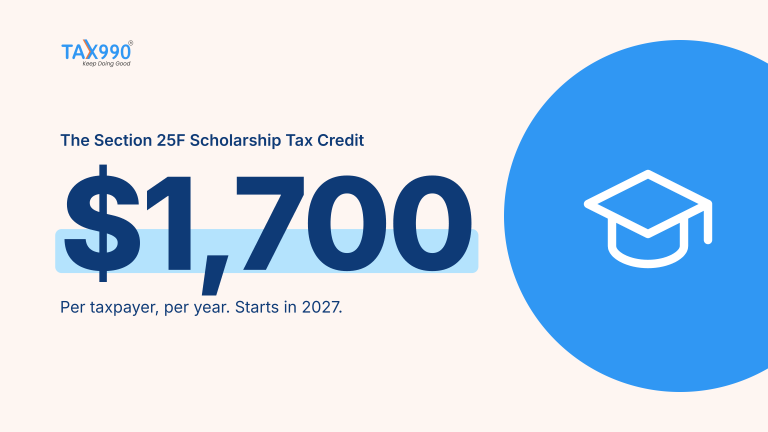
Beginning January 1, 2027, individual donors can claim a federal tax credit of up to $1,700 for cash contributions to scholarship granting organizations (SGOs). For nonprofits that fund K-12 scholarships, that’s a meaningful new reason for donors to give. It also raises a question many organizations haven’t revisited in years: can you show the IRS that you’re a public charity?
To qualify as a scholarship granting organization under the new federal credit, your organization must be a 501(c)(3) public charity, not a private foundation. Schedule A is where you show the IRS which public charity classification applies to you.
What Is the New Federal Scholarship Tax Credit?
The Federal Scholarship Tax Credit, also called the Education Freedom Tax Credit, is a nonrefundable credit created under Internal Revenue Code Section 25F. It reduces a donor’s federal income tax dollar for dollar, up to $1,700 per year, minus any state tax credit claimed for the same gift.
A scholarship granting organization (SGO) is a 501(c)(3) public charity that awards K-12 scholarships to eligible students and is listed by a participating state. Each state must elect to take part and give the IRS its list of SGOs. As of mid-September 2026, the IRS lists 30 participating states, including Florida, Georgia, Ohio, South Carolina, Tennessee, and Texas.
Section 25F also sets operating rules for SGOs:
- Public charity status. Described in section 501(c)(3), exempt under section 501(a), and not a private foundation.
- Scholarship spending. At least 90 percent of income is spent on scholarships for eligible students.
- Broad reach. Scholarships for at least 10 students attending more than one school.
- Separate accounts. Qualified contributions held separately.
- No earmarking. Donors can’t direct gifts to a specific student.
- No benefit to insiders. Scholarships can’t go to board members, substantial donors, or their families.
- Student income limits. Household income no greater than 300 percent of area median gross income.
Can a Private Foundation Be a Scholarship Granting Organization?
No. Section 25F requires an SGO to be a 501(c)(3) organization that isn’t a private foundation. A private foundation that wants to fund K-12 scholarships under the credit would need a separate public charity to serve as the SGO.
Unsure which classification fits? See our guide to 501(c)(3) and 509 classifications.
What Schedule A Shows the IRS About Your Public Charity Status
Schedule A (Form 990 or 990-EZ), Public Charity Status and Public Support, is where a 501(c)(3) organization identifies its public charity classification and, in many cases, proves it each year. Every 501(c)(3) public charity that files Form 990 or Form 990-EZ must complete it. For a part-by-part walkthrough, read our Form 990 Schedule A quick guide.
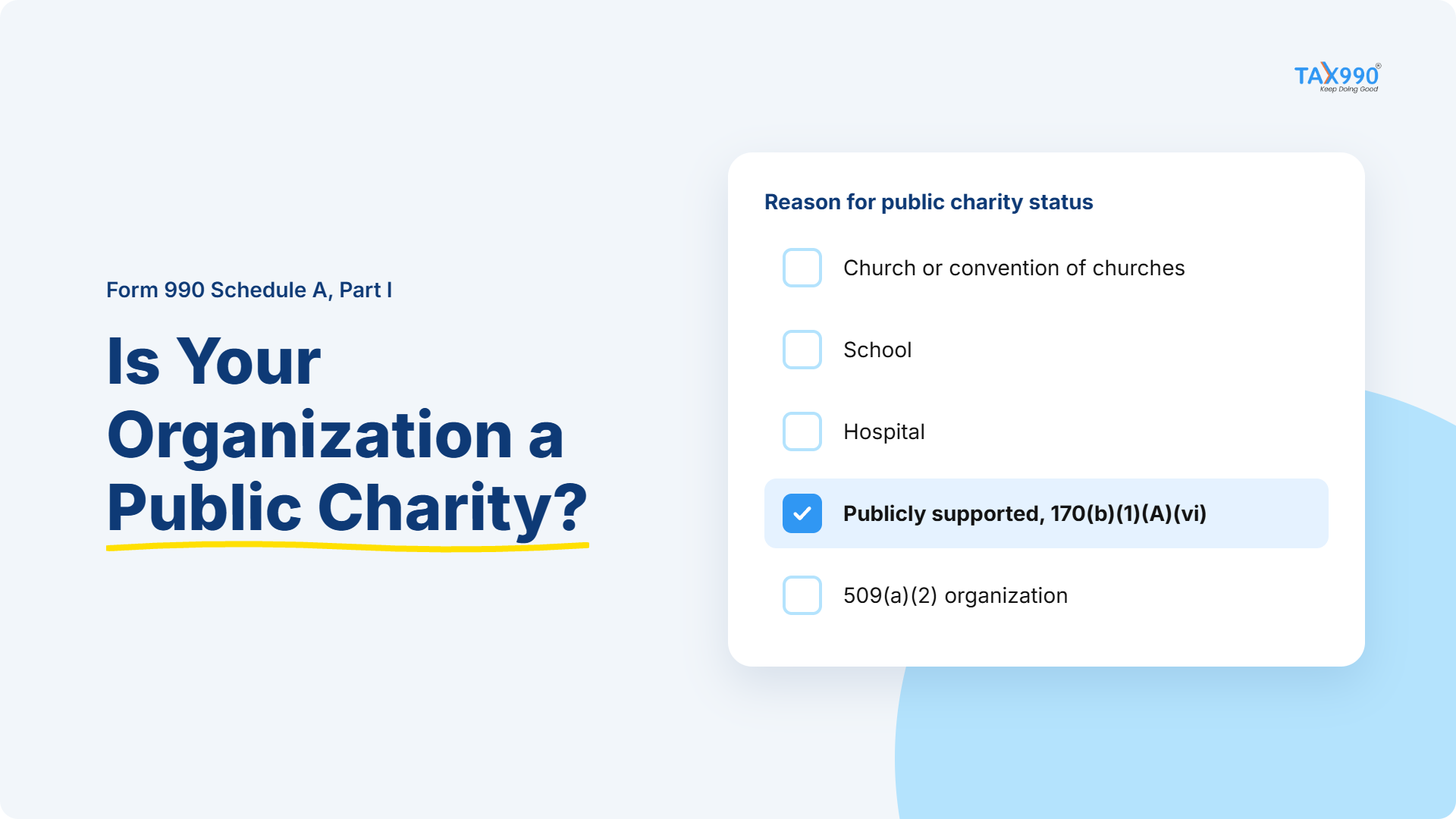
Part I: Your Reason for Public Charity Status
Part I asks you to check the one box that explains why your organization isn’t a private foundation. Churches, schools, and hospitals qualify based on what they are. Most SGOs will qualify based on where their support comes from, under section 509(a)(1) and 170(b)(1)(A)(vi), or under section 509(a)(2).
Parts II and III: The Public Support Test
Publicly supported organizations prove their status with five years of numbers. The IRS Schedule A instructions set out two tests:
| Test | Schedule A part | Public support threshold | Investment income limit |
| 170(b)(1)(A)(vi) | Part II | 33 1/3 percent of total support, or 10 percent plus a facts-and-circumstances showing | None |
| 509(a)(2) | Part III | More than 33 1/3 percent from gifts, grants, and exempt-activity receipts | No more than 33 1/3 percent from investment income and net unrelated business income |
During its first five years as a 501(c)(3), an organization qualifies as a public charity without completing the test. After that, an organization that fails the test for two consecutive years is treated as a private foundation.
What If Your Organization Files Form 990-N?
Organizations that file the Form 990-N e-Postcard don’t file Schedule A. If yours plans to serve as an SGO, keep your IRS determination letter and support records ready for your state’s SGO listing process.
How Scholarship Gifts Can Affect Your Public Support Test
Because the credit is capped at $1,700 per taxpayer, it’s likely to bring in many smaller gifts. That helps under the 170(b)(1)(A)(vi) test, because only the part of any one donor’s gifts above 2 percent of total support is excluded from public support.
An SGO that leans on a few large donors could see its public support percentage drop even as revenue grows. Run the five-year calculation before year-end so your board can adjust.
Steps to Take Before the Credit Takes Effect
- Confirm your classification. Check your IRS determination letter and Tax Exempt Organization Search listing.
- Review your last five years of Schedule A. Make sure the support figures are accurate and the Part I box still matches how you operate.
- Confirm your state is participating. Check the IRS list and your state’s process for joining its SGO list.
- Correct past errors. File a Form 990 amended return if an earlier Schedule A was wrong.
- Plan for the operating rules. Build procedures for separate accounts, student income verification, and the annual independent audit.
- Talk with your tax advisor. Treasury has issued regulations under Section 25F, and guidance may continue to develop.
For more on what public charities must file each year, see the Form 990 filing requirements for 501(c)(3) public charities.
How Tax990 Supports Your Schedule A Filing
Tax990 includes Schedule A in a guided workflow alongside your Form 990 e-filing or Form 990-EZ, with built-in error checks before you transmit. Every return is backed by the Tax990 Commitment, with IRS acceptance or your money back, plus free retransmissions and up to three amendments. Protection Plus is included automatically at no additional cost, with up to $1M in professional audit defense for up to three years after IRS acceptance.
Ready to file with confidence?
Create your free Tax990 account or see transparent Form 990 pricing.
Recent Posts
- Is Your Organization a Public Charity? Why Form 990 Schedule A Matters Under the New Scholarship Tax Credit
- Section 25F Scholarship Tax Credit: What 501(c)(3) Organizations Need to Know Before 2027
- Form 15644, Explained: What Group Exemption Numbers Need to File
- Nonprofit Board Meeting Agenda Best Practices: Stop Wasting Board Time
- Nonprofit Revenue Types and the Tax Rules Behind Each One