- Posted inin General
Do You Have to Register in Every State Where You Fundraise: A State-by-State Guide
- Posted byPatience Booker
- 0 Comments
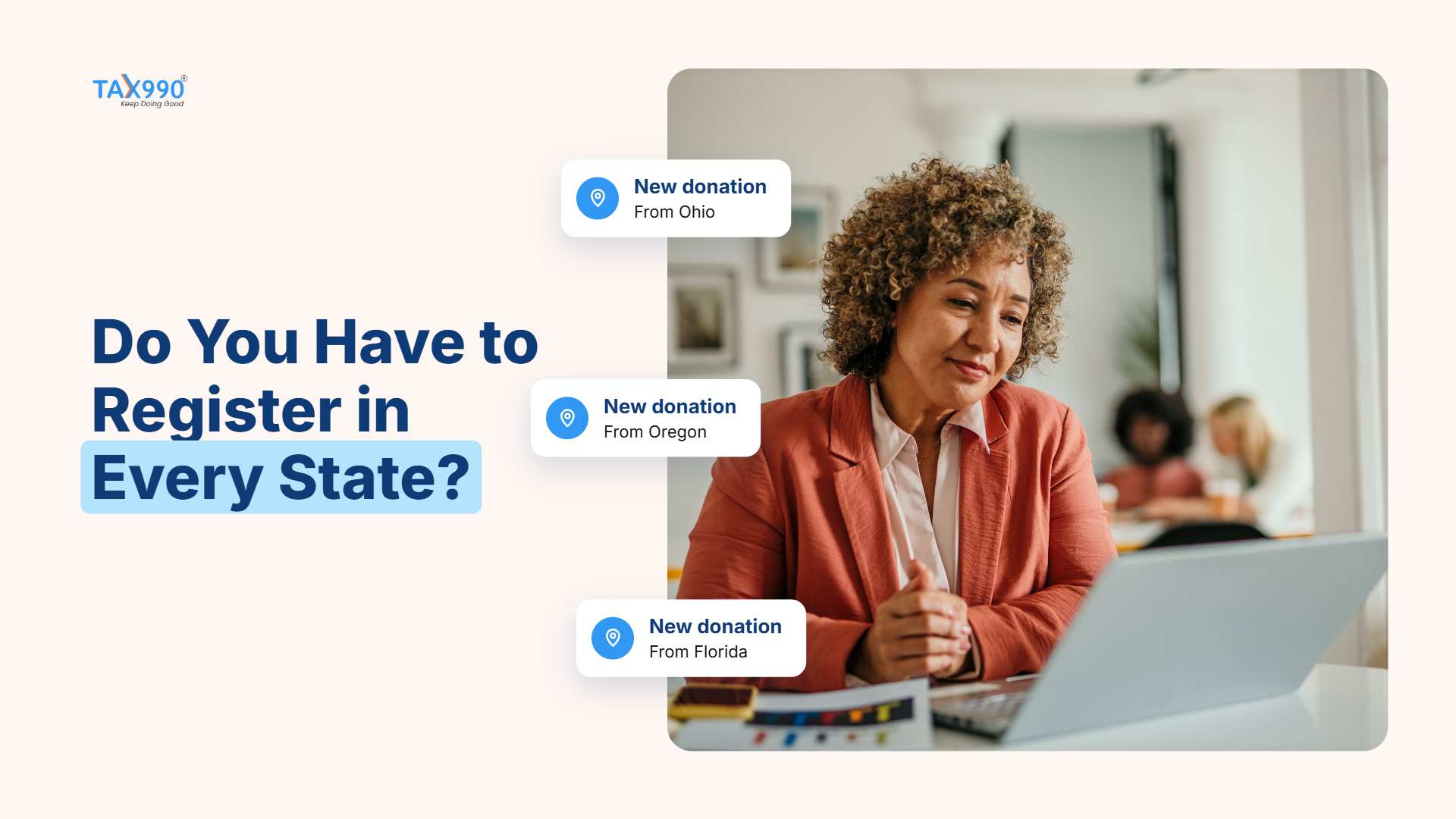
Your organization earned its 501(c)(3) status, set up a donation page, and started sharing it online. Then a board member asks a fair question: do we have to register in every state a donor lives in? The answer depends on charitable solicitation registration, a set of state rules that sits entirely apart from your IRS filings. Here’s how those rules work, what actually triggers them, and how to track them alongside your annual Form 990.
What Is Charitable Solicitation Registration?
Charitable solicitation registration is a state requirement that a nonprofit register with that state’s charity regulator, usually the Attorney General or Secretary of State, before asking the state’s residents for donations. Most states also require an annual renewal with updated financial information.
The goal is donor protection. States want to know who is raising money from their residents, how much they raise, and how they use it. Registration gives regulators and donors a public record to check, much like your Form 990 does at the federal level. Read more about what your Form 990 tells donors and the public.
Why It’s Separate From Federal Tax-Exempt Status
Federal tax-exempt status and state solicitation registration answer two different questions. The IRS decides whether your organization qualifies as tax-exempt under section 501(c)(3). Each state decides whether your organization may ask its residents for money.
Your IRS determination letter doesn’t register you in any state. The IRS notes that approximately 40 states have charitable solicitation statutes that generally require registration before soliciting, each with its own exemptions. The reverse also holds. A state registration says nothing about your federal exemption, which you protect by filing every year. See how nonprofits lose and regain tax-exempt status. Keeping your Form 990 filing current with the IRS is still its own obligation.
Do You Have to Register in Every State If You Accept Online Donations?
No, not automatically. A “Donate” button on your website doesn’t, by itself, require registration in all 50 states. This is one of the most common misconceptions in nonprofit fundraising compliance, and it leads some small organizations to over-register while others ignore the rules completely.
Most state regulators look to the Charleston Principles for guidance on online fundraising registration. The National Association of State Charity Officials (NASCO) drafted these guidelines in 1999. Under them, an organization based outside a state generally needs to register there for online solicitation only when it specifically targets that state’s residents, or receives contributions from the state on a repeated and ongoing or substantial basis.
The Charleston Principles are guidelines, not law. Each state applies its own statute, and some regulators read their rules more broadly. Treat them as a starting point for your analysis, then confirm with each state where you have donors.
What Triggers Charitable Solicitation Registration?
Three general triggers determine whether a state expects your organization to register:
- Physical presence. If your organization is based in a state, or has an office, staff, or chapter there, expect to register in that state before soliciting, whether you fundraise online or off.
- Direct solicitation. Asking residents for donations by mail, email, phone, events, or ads aimed at that state generally counts as soliciting there. Under the Charleston Principles, emails sent to people you know or should know live in a state are treated like direct mail or phone appeals.
- In-state donors above a threshold. Even without targeting a state, steady giving from its residents can trigger registration. The Charleston Principles suggest states set benchmarks, such as 100 or more online contributions in a year, or $25,000 or more in contributions. States set their own numbers, so check each one.
Many states also exempt certain organizations, such as religious organizations or groups that raise less than a set amount and don’t pay anyone to solicit. Pennsylvania, for example, exempts organizations that receive $25,000 or less in annual contributions and don’t compensate anyone to fundraise. Some exemptions apply automatically, while others require you to file for them.
How Charitable Registration Connects to Your Form 990
State registration and your IRS return are separate, but in practice they share a calendar. Many states require a copy of your most recent Form 990, 990-EZ, or 990-PF with each annual renewal, and some accept a financial report instead. Several states set renewal deadlines at four months and 15 days after fiscal year end, the same timing as the Form 990 filing due date.
That shared timing makes a late Form 990 a state problem too, on top of the Form 990 late filing penalties the IRS can assess. One delayed return can hold up renewals in every state that asks for it. Keep in mind that an IRS extension with Form 8868 doesn’t automatically extend state deadlines. Most states have their own extension process.
Charitable Registration by State: Reference Table
Use this table as a starting point for charitable registration by state. Rules change often, so confirm current requirements with each state’s charity regulator before you solicit or renew.
| Registration status | States |
| Generally required | Alabama, Alaska, Arkansas, California, Colorado, Connecticut, District of Columbia, Florida, Georgia, Hawaii, Illinois, Kansas, Kentucky, Maine, Maryland, Massachusetts, Michigan, Minnesota, Mississippi, Nevada, New Hampshire, New Jersey, New Mexico, New York, North Carolina, North Dakota, Ohio, Oklahoma, Oregon, Pennsylvania, Rhode Island, South Carolina, Tennessee, Utah, Virginia, Washington, West Virginia, Wisconsin |
| Limited or exemption filing | Arizona (veterans’ organizations), Louisiana (organizations using paid solicitors), Missouri (501(c)(3) organizations file for exemption), Texas (public safety and veterans’ organizations) |
| No general registration | Delaware, Idaho, Indiana, Iowa, Montana, Nebraska, South Dakota, Vermont, Wyoming |
Typical Renewal Deadlines for Calendar-Year Organizations
For an organization with a fiscal year ending December 2026, common state renewal deadlines fall at these points in 2027:
| Renewal timing | Due date (Dec. 31 year end) | Example states |
| Four months and 15 days after year end | May 15 | California, Massachusetts, New York, Oregon, South Carolina, Virginia |
| Five months and 15 days after year end | June 15 | North Carolina |
| Six months after year end | June 30 | Illinois, New Jersey, Tennessee |
| 15th day of the seventh month | July 15 | Minnesota |
| Seven months after year end (submit at least 30 days early) | July 31 | Michigan |
| Fixed annual date | July 31, Sept. 1, Nov. 30 | Wisconsin (July 31), Alaska and North Dakota (Sept. 1), Maine (Nov. 30) |
| 10 to 11 months after year end | Nov. 15 or Nov. 30 | Pennsylvania (Nov. 15), Washington (Nov. 30) |
| Registration anniversary | Varies | Florida |
Your State-by-State Checklist
Work through these steps once a year, ideally when you plan your Form 990 filing. Our complete guide to Form 990 deadlines covers the federal side of the calendar.
- List every state where you have a physical presence, including offices, staff, board meetings, and chapters.
- List every state where you solicit directly, including mailings, email campaigns, events, and targeted ads.
- Pull last year’s donations by state and compare the count and total to each state’s threshold.
- Check each flagged state’s rules for exemptions you may qualify for and whether you need to file to claim them.
- Add each renewal deadline to your annual filing calendar, next to your Form 990 due date.
- File your Form 990 on time so your return is ready when state renewals ask for a copy.
- Track state extensions separately from your IRS extension.
File Your Form 990 With Confidence
Your Form 990 is the anchor for most state renewals, so getting it right and on time keeps the rest of your calendar on track. Tax990 guides you through Form 990, 990-EZ, 990-N, and 990-PF step by step, with built-in error checks before you transmit. Every return is backed by the Tax990 Commitment: IRS acceptance or your money back, free amendments (up to three) and retransmissions, and Form 8868 extension filing included. Protection Plus audit defense is included automatically at no additional cost.
Ready to file? Create your free Tax990 account or see transparent Form 990 pricing.
Recent Posts
- Do You Have to Register in Every State Where You Fundraise: A State-by-State Guide
- What to Do When the IRS Rejects Your Nonprofit’s Return for Information It Already Has
- Form 8822-B: Why Keeping Your Nonprofit’s IRS Information Current Matters
- Fiscal Sponsorship vs. Starting a Nonprofit: Form 990 Rules
- Form 843 for Nonprofits: How to Request a Tax Refund or Penalty Abatement