- Posted inin General
Beyond Form 990: The Other Returns Nonprofits Still Have to File
- Posted byPatience Booker
- 0 Comments
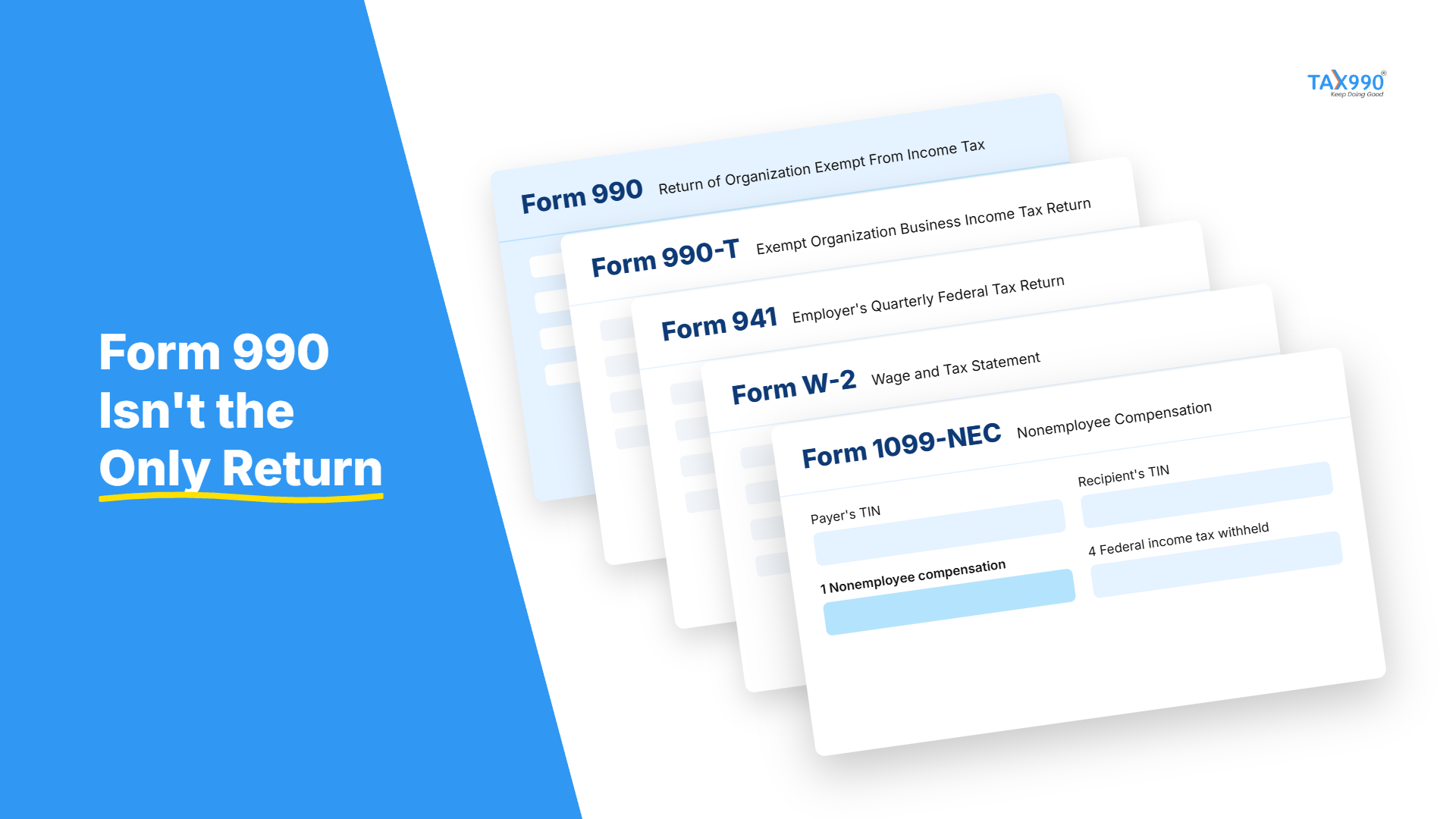
Every year, nonprofits put real care into Form 990. It’s the return that keeps tax-exempt status in good standing and shows donors how an organization uses its resources. Form 990 is one piece of a larger set of nonprofit filing requirements, though, and the other pieces have their own forms, deadlines, and penalties.
Nonprofit filing requirements are the federal and state returns an organization must submit to keep its tax-exempt status and meet its obligations as an employer, payer, and registered entity. Beyond Form 990, the most common are Form 990-T, payroll tax returns, Forms W-2 and 1099-NEC, and state annual reports. Here’s what each one covers and how to tell which apply to your organization.
Form 990-T for Unrelated Business Income
Tax-exempt status covers income from activities related to your exempt purposes. It doesn’t cover everything. Unrelated business income is revenue from a trade or business that’s regularly carried on and not substantially related to the organization’s exempt purposes. Think of a museum renting its parking lot on weekends or a nonprofit selling advertising in its newsletter.
An organization with $1,000 or more of gross income from an unrelated business must file Form 990-T, according to the IRS guidance on unrelated business income tax. Most organizations file it by the 15th day of the fifth month after their tax year ends, which is the same date Form 990 is due for calendar-year filers (IRS Form 990-T instructions). Read our guide to what nonprofits get wrong about unrelated business income for examples of activities that trigger this return.
Payroll Tax Returns
Once a nonprofit hires its first employee, it takes on the same payroll responsibilities as any other employer. That means withholding federal income tax, Social Security, and Medicare from wages and reporting them to the IRS.
Most employers report these taxes quarterly on Form 941. Some very small employers may qualify to file Form 944 once a year instead.
There’s one notable difference for charities. Organizations exempt under section 501(c)(3) don’t pay federal unemployment (FUTA) tax, and the IRS notes this exemption can’t be waived (IRS: Exempt organizations and employment taxes). Other exempt organizations, such as 501(c)(4) social welfare groups and 501(c)(6) trade associations, generally do owe FUTA tax and file Form 940. State unemployment rules vary, so check with your state workforce agency.
Our post on payroll basics for nonprofits covers how to set up a payroll process that stays organized all year.
Forms W-2 and 1099-NEC
Payroll returns report totals to the IRS. Forms W-2 and 1099-NEC report what each individual was paid.
- Form W-2 goes to every employee and to the Social Security Administration by January 31.
- Form 1099-NEC goes to independent contractors your organization pays for services, such as a freelance grant writer or bookkeeper. For payments made in 2026, the reporting threshold rose to $2,000 from the long-standing $600. The form is due to the contractor and the IRS by January 31 (IRS Instructions for Forms 1099-MISC and 1099-NEC).
Both deadlines land just after year-end, when many nonprofit teams are also closing their books. Our roundup of January 31 deadlines that may affect your nonprofit can help you plan ahead.
State Annual Reports and Registrations
State obligations often catch organizations off guard because they vary so widely. Depending on where you’re incorporated and where you raise money, you may need to file:
- An annual report with the secretary of state to keep your corporation in good standing
- A charitable solicitation registration or renewal before asking residents for donations
- A state tax return, such as California Form 199 for exempt organizations in California
Missing a state filing can lead to administrative dissolution or the loss of permission to fundraise, even when your federal filings are current. Look up your state’s forms and due dates in the Tax990 state filing requirements directory, and read what nonprofits need to know about state filings for more context.
Which Nonprofit Filing Requirements Apply to Your Organization?
Not every organization files every return. Your obligations depend on your size, your activities, and whether you have staff. Use this table as a starting point, and confirm form thresholds in the IRS annual filing requirements overview.
| Return | Who files it | When it’s due |
| Form 990-N, 990-EZ, or 990 | Most tax-exempt organizations, with the form based on gross receipts and assets | 15th day of the 5th month after year-end |
| Form 990-T | Organizations with $1,000 or more of gross unrelated business income | 15th day of the 5th month after year-end (most organizations) |
| Form 941 or 944 | Organizations with paid employees | Quarterly (941) or annually (944) |
| Form 940 | Employers that aren’t 501(c)(3) organizations | Annually |
| Form W-2 | Organizations with paid employees | January 31 |
| Form 1099-NEC | Organizations paying a contractor $2,000 or more (2026 payments) | January 31 |
| State annual report or registration | Varies by state | Varies by state |
A volunteer-run organization with gross receipts of $50,000 or less may only need to file Form 990-N and a state annual report. A mid-sized 501(c)(3) with staff, contractors, and a gift shop could be responsible for nearly every return on this list.
Form 990 is only one part of what your organization files each year. For the other federal returns in this table (Forms 941, 944, 940, W-2, and 1099-NEC), TaxBandits, our sister product, lets you e-file with the IRS and send copies to employees and contractors. Your team can handle payroll and contractor reporting in one place, alongside your annual Form 990 filing. Get started with TaxBandits.
Where Form 990 Fits in the Bigger Picture
Form 990 remains the center of your federal compliance. It’s the return the IRS uses to confirm your organization still qualifies for exemption, and failing to file for three consecutive years leads to automatic revocation of tax-exempt status. Many of the other returns connect back to it. Form 990 asks whether you filed Form 990-T and how many Forms W-2 and 1099 you issued, so consistent records across all of them make each filing easier. Our complete guide to Form 990 deadlines lays out every due date by fiscal year end.
Tax990 supports the full Form 990 series, plus Form 990-T, Form 8868 extensions, and California Form 199, through a guided workflow with built-in error checks. Every return is backed by the Tax990 Commitment: IRS acceptance or your money back, plus free amendments and retransmissions. Protection Plus is included automatically at no additional cost, with up to $1 million in professional audit defense for three years after IRS acceptance.
Ready to file?
Create your free Tax990 account or see transparent Form 990 pricing.
Recent Posts
- Beyond Form 990: The Other Returns Nonprofits Still Have to File
- How to Get a Copy of Your 501(c)(3) Letter (If You Lost It)
- Do You Have to Register in Every State Where You Fundraise: A State-by-State Guide
- What to Do When the IRS Rejects Your Nonprofit’s Return for Information It Already Has
- Form 8822-B: Why Keeping Your Nonprofit’s IRS Information Current Matters