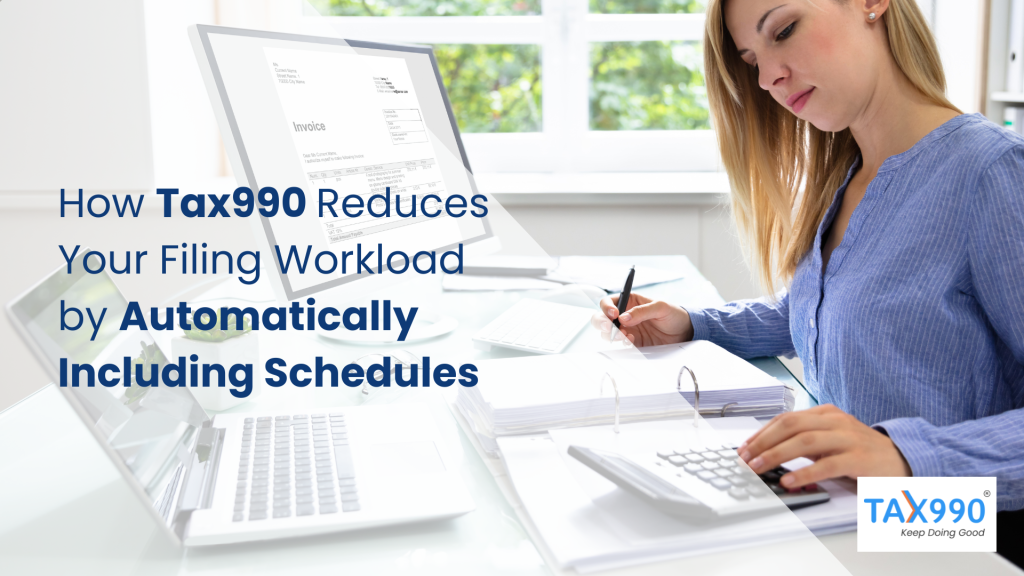
How Tax990 Reduces Your Filing Workload by Automatically Including Schedules
Estimated reading time: 16 minute(s)
Tax compliance often involves managing documentation, requirements, schedules, and deadlines. When each return requires repetitive data entry and careful cross-checking, the filing process can quickly become time-consuming.
But with Tax990, the process is simplified.
What are Form Schedules?
Form schedules are supplemental documents that accompany a primary tax form to provide additional details required by the IRS. While the main form captures high-level information, schedules break down specific data in a standardized way. This can include financial activities, compensation details, or organizational operations.
Understanding Form 990 Schedules
Form 990 schedules are crucial for detailing specific aspects of your organization’s operations, financial activities, and compliance.
Not every organization is required to complete every schedule. The IRS mandates specific schedules based on factors such as the organization’s type, activities, and the financial information it must report. This section will help you understand when and why each schedule is required, ensuring you complete your filing accurately and in compliance with IRS regulations.
A Breakdown of Form 990 Schedules
Schedule A is required to show that the organization is supported by the public. This is important for maintaining public charity status rather than private foundation status. 990 and 990-EZ filers may have to complete this form.
Schedule B is used to provide specific information on your organization’s contributors who gave more than $5,000. Filers 990, 990-EZ, and 990-PF may have to complete this form.
Schedule C is used to furnish additional information on political campaign activities or lobbying activities. 990 and 990-EZ filers may have to complete this form.
Schedule D is used to provide the required reporting for donor-advised funds, conservation easements, certain art and museum collections, escrow or custodial accounts or arrangements, endowment funds, and supplemental financial information. 990 filers may have to complete this form.
Schedule E is used to report various details about the school’s policies. 990 and 990-EZ filers may have to complete this form.
Schedule F is used to provide information on activities conducted outside the United States by the organization at any time during the tax year. 990 filers may have to complete this form.
Schedule G is used to report professional fundraising services, fundraising events, and gaming. 990 and 990-EZ filers may have to complete this form.
Schedule H is used to provide information on the activities and policies of, and community benefits provided by, its hospital and other non-hospital health care facilities that it operated during the tax year. This includes facilities that operate either directly or through disregarded entities or joint ventures. 990 filers may have to complete this form.
Schedule I is needed if the organization gave more than $5,000 in grants or assistance to domestic individuals, organizations, or governments. 990 filers may have to complete this form.
Schedule J is used by an organization to report compensation information for officers, directors, individual trustees, key employees, and the highest-compensated employees, as well as compensation practices. 990 filers may have to complete this form.
Schedule L is used to report on financial transactions on arrangements between the organizations and disqualified person(s) under section 4958 or other interested persons. Schedule L is also used to determine whether a member of the organization’s governing body is an independent member. 990 and 990-EZ filers may have to complete this form.
Schedule M is used to report the types of noncash contributions received during the year and information regarding such contributions. The schedule requires reporting the quantity and the reported financial statement amount of noncash contributions received by type of property. 990 filers may have to complete this form.
Schedule N is used when reporting that the organization has ceased operations or disposed of more than 25% of its net assets through sale, exchange, or other disposition. 990 and 990-EZ filers may have to complete this form.
Schedule O is used to provide the IRS with narrative information required for responses to specific questions on Form 990 or 990-EZ, and to explain the organization’s operations.
Schedule R is used to provide information on related organizations, transactions with related organizations, and certain unrelated partnerships through which the organization conducts significant activities. 990 filers may have to complete this form.
How Tax990 Reduces Your Filing Workload
Tax990 reduces the filing workload by automatically including the required schedules in your return at no additional cost.
Instead of manually reviewing IRS instructions to determine which schedules apply, Tax990 evaluates the information previously entered and identifies the relevant requirements for your organization. Additionally, Tax990 automates data entry by pre-filling some data into the required schedules.
This eliminates repetitive data entry and minimizes the risk of errors or omissions caused by missing or incorrect schedules. By streamlining schedule selection and preparation, Tax990 helps ensure a complete and accurate filing while significantly reducing the time and effort required.
Start Filing with Tax990
Navigating Form 990 schedules does not have to be complex or overwhelming. Tax990 simplifies compliance through intelligent schedule selection that reduces manual effort and improves accuracy.
This ease of filing is backed by the Tax990 Commitment, which supports nonprofits with complimentary extension requests, free transmission of rejected returns, no-cost amendments, and a guaranteed IRS approval or money-back guarantee, providing confidence and peace of mind throughout the filing process.


Leave a Comment