- Posted inin General
Section 25F Scholarship Tax Credit: What 501(c)(3) Organizations Need to Know Before 2027
- Posted byPatience Booker
- 0 Comments
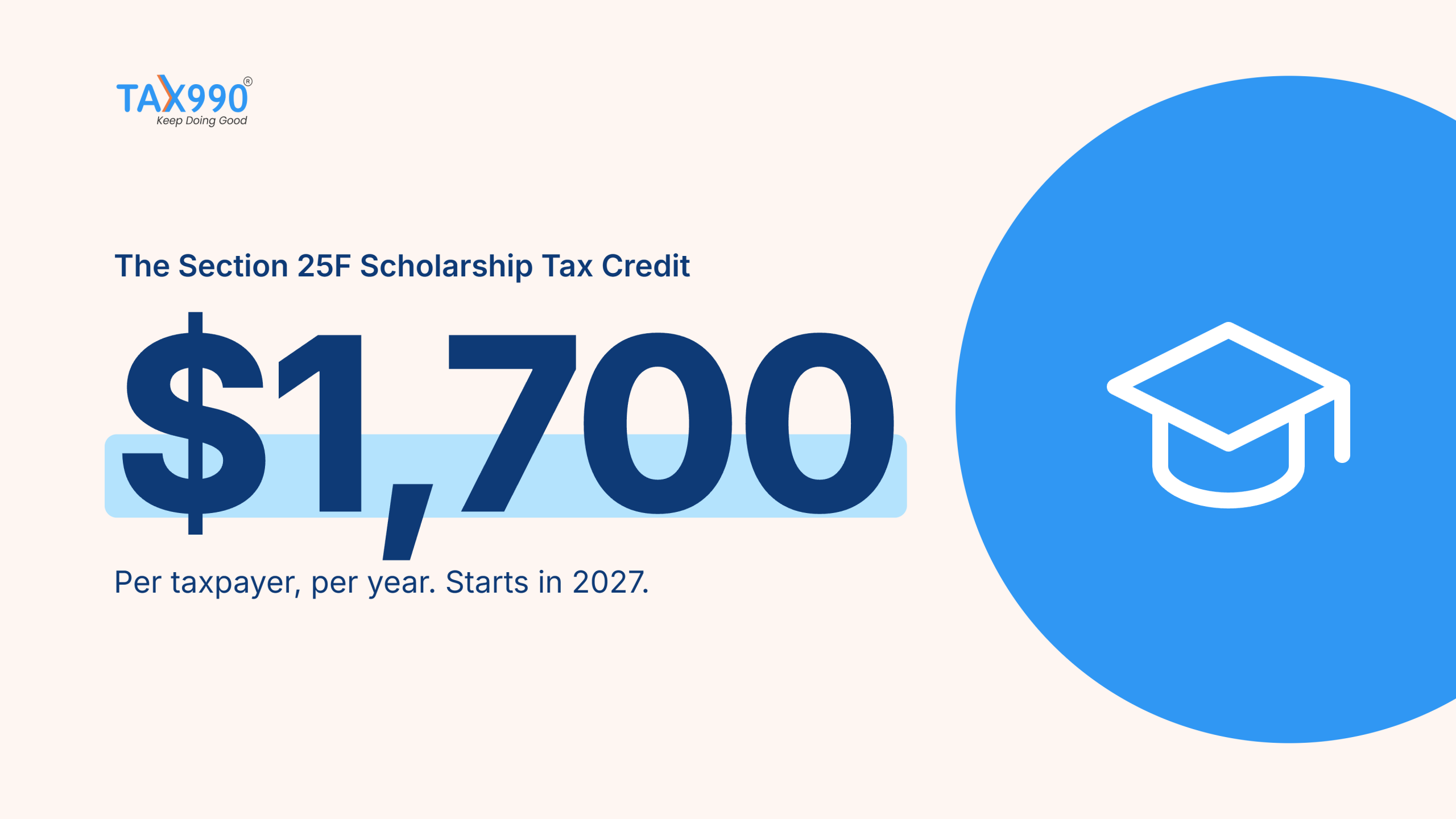
The Section 25F scholarship tax credit is a federal tax credit, starting January 1, 2027, that lets individual taxpayers claim up to $1,700 a year for cash contributions to qualifying scholarship granting organizations in participating states. If your 501(c)(3) organization funds K-12 scholarships, or is thinking about it, this credit could change how your donors give. It also comes with operating rules that need to be in place before the first credit-eligible gift arrives.
Here’s what the law requires, what the IRS released on October 1, 2026, and what your organization can do now to get ready.
What Is the Section 25F Scholarship Tax Credit?
The One, Big, Beautiful Bill Act added Section 25F to the Internal Revenue Code. The credit is also called the Federal Scholarship Tax Credit or the Education Freedom Tax Credit. It gives individual taxpayers a dollar-for-dollar credit for qualified contributions to a scholarship granting organization (SGO), up to $1,700 per taxpayer each year. The IRS says married couples filing jointly can claim up to $3,400.
A few donor-side rules will shape how you talk about the credit:
- Individuals only. Section 25F is an individual income tax credit, so corporate and foundation gifts don’t generate it.
- Cash only. A qualified contribution has to be a charitable contribution of cash.
- No double benefit. Donors can’t claim both the credit and a Section 170 charitable deduction for the same gift.
- State credits reduce it. The federal credit goes down by any state tax credit the donor claims for the same contribution.
- Unused credit carries forward. Donors can carry unused amounts forward for up to five years.
That’s a different message than a typical year-end appeal, and your donor communications should reflect it.
Key Dates for the Federal Scholarship Tax Credit
- October 1, 2026: Treasury and the IRS released proposed and temporary regulations.
- January 1 of each year: Participating states submit their list of qualifying SGOs to the IRS.
- January 1, 2027: Credit-eligible contributions begin.
Which States Are Participating?
The credit only applies where a state opts in. As of September 14, 2026, the IRS lists 30 states with advance elections for 2027: Alabama, Alaska, Arkansas, Colorado, Florida, Georgia, Idaho, Indiana, Iowa, Kansas, Kentucky, Louisiana, Mississippi, Missouri, Montana, Nebraska, Nevada, New Hampshire, North Carolina, North Dakota, Ohio, Oklahoma, South Carolina, South Dakota, Tennessee, Texas, Utah, Virginia, West Virginia, and Wyoming.
If your state isn’t participating, gifts to your organization won’t qualify for the credit, even if you meet every other requirement. You can check the current list on the IRS Federal Scholarship Tax Credit page.
What Makes a 501(c)(3) a Qualifying Scholarship Granting Organization?
A scholarship granting organization (SGO) is a 501(c)(3) public charity that spends at least 90 percent of its income on K-12 scholarships for eligible students and appears on its state’s SGO list. An eligible student is one whose household income isn’t greater than 300 percent of the area median gross income.
Here’s what Section 25F of the Internal Revenue Code requires:
| Requirement | What it means | Code section |
| Public charity status | 501(c)(3), exempt under 501(a), and not a private foundation | 25F(c)(5) |
| Minimum reach | Scholarships to 10 or more students who don’t all attend the same school | 25F(d)(1)(A) |
| 90 percent spending | At least 90 percent of income goes to scholarships for eligible students | 25F(d)(1)(B) |
| Qualified expenses only | Elementary and secondary education expenses under Section 530(b)(3)(A) | 25F(d)(1)(C) |
| Priority rules | Priority for prior-year recipients and their siblings | 25F(d)(1)(D) |
| No earmarking | Contributions can’t be set aside for specific students | 25F(d)(1)(E) |
| Income verification | Verify household income and family size | 25F(d)(1)(F) |
| No self-dealing | No scholarships to disqualified persons | 25F(d)(2) |
Can an Existing Nonprofit Become a Scholarship Granting Organization?
Yes, the statute doesn’t require a brand-new entity. Any 501(c)(3) that isn’t a private foundation can qualify if it meets every requirement and gets on its state’s list. The harder part for an organization with other programs is the 90 percent test, which the statute applies to “the income of the organization,” so spending on unrelated programs can make it hard to pass.
That’s why some schools and multi-program nonprofits are setting up or partnering with a separate, single-purpose SGO. Talk with your tax advisor before choosing a structure.
What Changed With the October 2026 Regulations?
On October 1, 2026, Treasury and the IRS released proposed and temporary regulations for Section 25F. According to the IRS announcement, SGOs must:
- Keep qualified contributions separate from other funds
- Complete annual reporting and audits
- Appear on their state’s SGO list to receive credit-eligible gifts
The rules also prevent states from adding operating requirements stricter than federal law, and they include a safe harbor for multistate organizations whose activities are at least 85 percent scholarship granting. Organizations that don’t meet the requirements can be removed from eligible lists.
How Section 25F Could Affect Your Form 990
Credit-eligible giving can change your organization’s numbers, and your annual return will show it.
Public Charity Status Becomes a Gate
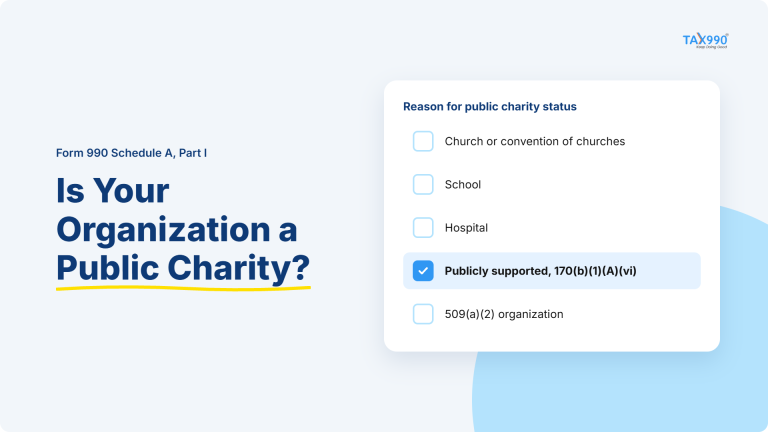
Private foundations can’t qualify as SGOs, so your public charity classification on Schedule A now determines whether you can participate at all. If you’re not sure how your support is measured, read the public support test, explained. Our Form 990 Schedule A quick guide covers the rest of the schedule.
Scholarship Grants Appear in Your Schedules
Organizations that award grants to individuals generally report them on Schedule I, Part III. Clear records of who received scholarships, and how you verified eligibility, make this section easier to complete accurately. See how Tax990 automatically includes the schedules your return needs.
Growth Can Change Which Form You File
A rise in contributions can move your organization past a filing threshold. Organizations with gross receipts normally $50,000 or less can file Form 990-N, and those with gross receipts under $200,000 and total assets under $500,000 can file Form 990-EZ. Above those limits, you’ll e-file Form 990.
Five Steps to Take Before January 1, 2027
- Confirm your state’s status and how it accepts organizations onto its SGO list.
- Review your public charity status on your most recent Schedule A.
- Set up separate accounting for qualified contributions.
- Document your income verification process for the 300 percent of area median gross income limit.
- Update your scholarship policies to cover priority rules, earmarking, and disqualified persons.
File Your Return With Confidence
New credit programs bring new questions, and your annual return is where the answers get recorded. Tax990, an IRS-authorized e-file provider, supports the full 990 series with a guided workflow, built-in error checks, and the Form 990 schedules your organization needs. Every return is backed by the Tax990 Commitment: IRS acceptance or your money back, plus free amendments and retransmissions. Protection Plus audit defense is included automatically at no additional cost.
Create your free Tax990 account or see transparent Form 990 pricing.
Recent Posts
- Private Foundation Excise Tax on Net Investment Income: A Form 990-PF Guide
- Group Exemption Numbers and Form 990: Filing Requirements for Subordinate Organizations
- Understanding the 990-N Form: A Guide for Small Nonprofits
- Introducing 990-N Full Service: Our Experts Will File Your Form 990-N for You
- Choosing a Form 990 E-File Provider: What to Compare Beyond Price