
- Posted inin General
How to Report a Nonprofit Name Change to the IRS
- Posted byPatience Booker
- 0 Comments
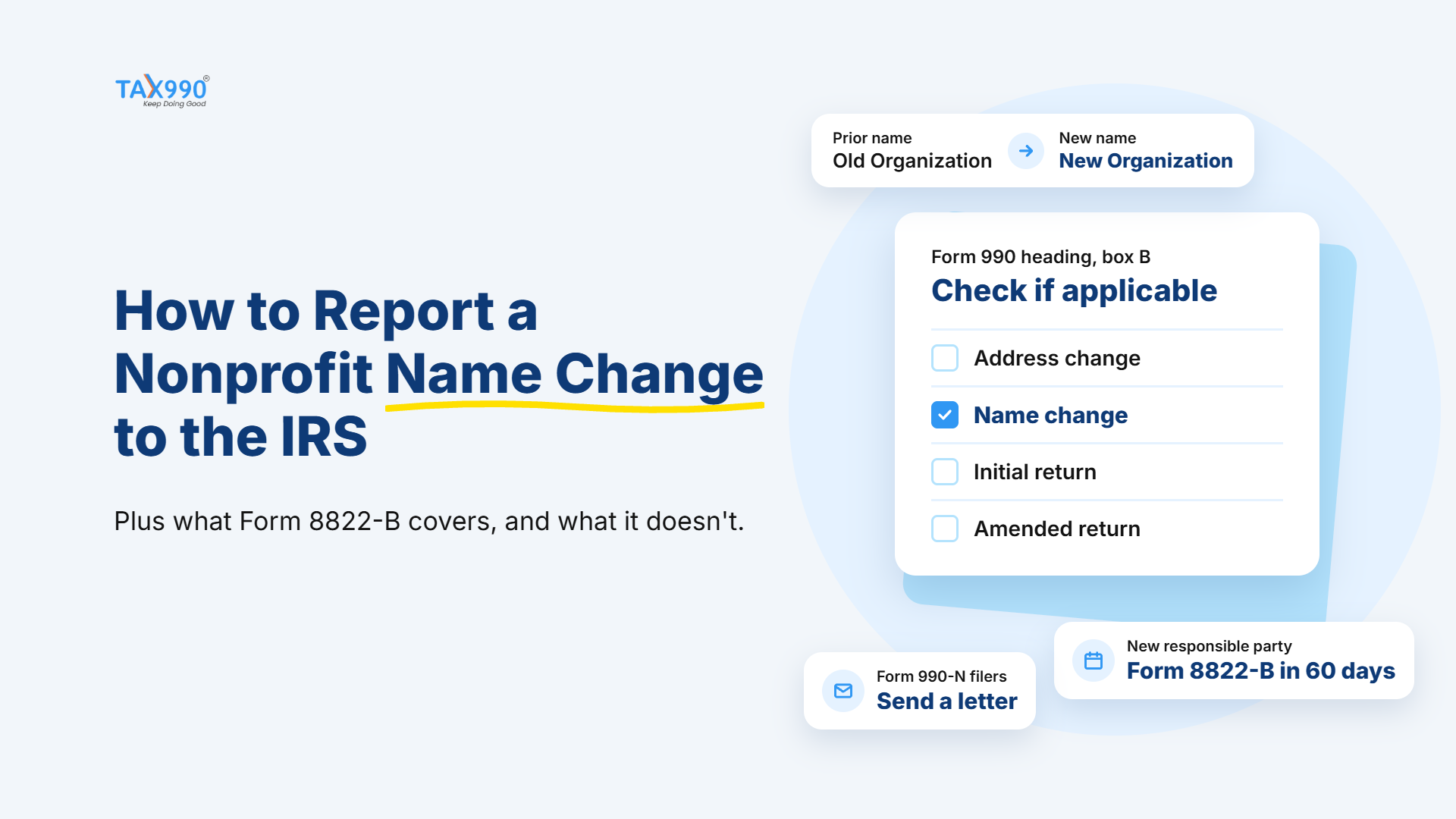
Start with your state. The IRS wants proof that the name change is legally effective, so amend your articles first.
If your organization files Form 990 or 990-EZ, check the Name change box in the heading of your next return and attach the supporting document. If you file Form 990-N or aren’t required to file an annual return, send a letter or fax to IRS Tax Exempt and Government Entities Customer Account Services instead. The letter needs your prior name, new name, EIN, and the signature and title of an officer or trustee.
The document you attach depends on how your organization is structured:
- Corporation: a copy of the amendment to your articles of incorporation, with proof it was filed with the state.
- Trust: a copy of the trust amendment or resolution showing the effective date, signed by at least one trustee.
- Unincorporated association: a copy of the amended articles, constitution, or other organizing document showing the effective date, signed by at least two officers, trustees, or members.
Can You Use Form 8822-B for a Business Name Change?
No. Form 8822-B covers address and responsible party changes only. Nonprofits report a new name through the annual return or the letter process above. Once the IRS updates its records, you can request an affirmation letter that shows your new name, which donors and grant makers often ask for. Our guide on how to read your IRS determination letter explains what that letter confirms.
What Is Form 8822-B Used For?
Form 8822-B, Change of Address or Responsible Party – Business, is the IRS form an organization with an EIN used to report a new mailing address, a new business location, or a new responsible party. Tax-exempt organizations use the same form and check the box that identifies them as exempt.
You can see every line of the form in our Form 8822-B template and instructions.
Reporting a 501(c)(3) Change of Address
A new address doesn’t carry a formal deadline, but file Form 8822-B as soon as you move. IRS notices, including penalty notices and letters about your exempt status, go to the address on file. You can also check Address change in the heading of your next annual return, though that may be months away. Mail Form 8822-B to the IRS address listed for your old location. If you still paper-file anything, check the current Form 990 mailing addresses too.
Form 8822-B Change of Responsible Party: The 60-Day Rule
This is the one change with a firm deadline. If your organization’s responsible party changes, you must file Form 8822-B within 60 days.
The responsible party is the individual who controls, manages, or directs the organization and its funds and assets. For most nonprofits, that’s a principal officer such as the executive director or board president. When that person steps down, file Form 8822-B within 60 days of the transition. That keeps the change of responsible party on your EIN current. If you’re still setting up your organization’s EIN, our guide on how to apply for an EIN as a nonprofit explains who to list from the start.
Can Form 8822-B Be Filed Electronically?
No. The IRS accepts Form 8822-B by mail only, so send it to the address on the form that matches your old business location. Keep a copy and note the date you mailed it, especially for a responsible party change.
Reporting New Leadership
Board and officer turnover doesn’t require a separate IRS filing unless the responsible party changes. Your next annual return captures the rest. Form 990 lists current officers, directors, trustees, and key employees in Part VII. Form 990-EZ lists them in Part IV, and the Form 990-N e-Postcard asks for your principal officer’s name and address.
What Should a Nonprofit Do If Its Activities Change From Its Exemption Application?
Report the change on your next annual return. On Form 990, describe new program services in Part III, line 2, and significant changes to how you conduct programs in Part III, line 3. Report changes to your governing documents in Part VI, line 4, and explain them on Schedule O. Form 990-EZ filers answer Part V, lines 33 and 34, and attach a conformed copy of any amended documents.
If a change goes beyond your exempt purposes, or you want to move to a different 501(c) classification, talk with a tax professional before you act. Some changes require a new exemption application rather than a note on your return. Our guide to reporting program service accomplishments on Form 990 shows how to describe your work clearly.
A Quick Checklist After Any Organizational Change
- Amend your governing documents and file them with your state.
- File Form 8822-B within 60 days if your responsible party changed.
- File Form 8822-B promptly if your address changed.
- Send a name change letter if you file Form 990-N.
- Check the correct boxes and describe the changes on your next annual return.
- Update your state charity registration, bank, and grantmakers.
If you already filed a return with outdated information, you can correct it. Our guide on how to amend Form 990 covers the process.
Report Your Changes Accurately With Tax990
When it’s time to file your annual return, Tax990’s guided workflow walks you through the heading, Part III, Part VI, and Schedule O, so your name, address, and program changes land in the right places. Built-in error checks catch common issues before you transmit. Every return is backed by the Tax990 Commitment: IRS acceptance or your money back, with up to three free amendments and free retransmissions. Protection Plus audit defense is included automatically at no additional cost.
Ready to file? Create your free Tax990 account or see transparent Form 990 pricing.
Recent Posts
- How to Report a Nonprofit Name Change to the IRS
- Nonprofit Document Retention Policy: A Free Template and the Form 990 Question It Answers
- The Governance Questions on Form 990 Part VI, Answered for Nonprofit Boards
- Tax990 Verification Code Not Arriving? Here’s What to Do
- Did Your IRA Receive a K-1? Here’s What You Need to Do Next