
- Posted inin General
Nonprofit Document Retention Policy: A Free Template and the Form 990 Question It Answers
- Posted byPatience Booker
- 0 Comments
Somewhere in your files sits a 2014 bank statement, a box of board minutes, and an old laptop nobody wants to wipe. Keeping everything feels safe, and tossing the wrong thing feels risky. A document retention policy settles that tension in writing, and Form 990 asks whether your organization has one.
A document retention policy is a written, board-adopted policy that tells an organization which records to keep, how long to keep them, and how to destroy them safely once that period ends. Below, you’ll find what the Form 990 question means, why it matters, and a free template your board can adapt and adopt.
What Does Form 990 Ask About Document Retention?
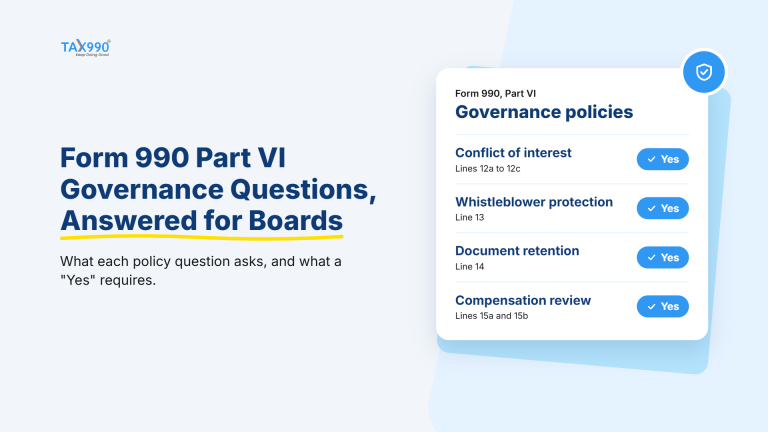
Form 990, Part VI, Section B, line 14 asks: “Did the organization have a written document retention and destruction policy?” The answer is a simple Yes or No, and no federal law requires your organization to have the policy.
So why does it matter? Part VI is the governance section of the return, and Form 990 is a public document. Donors, grant makers, watchdog groups, and journalists can review your filed returns under the public inspection rules, and a “No” on line 14 tells them your recordkeeping runs on habit rather than policy. The IRS Form 990 instructions explain that the governance questions are there because the IRS considers sound policies a sign of a well-run organization.
Form 990-EZ and Form 990-N don’t include this question, but a written policy is good stewardship at any size.
Why a Written Document Retention and Destruction Policy Matters
A written policy does two jobs. First, it supports legal compliance. Two provisions of the Sarbanes-Oxley Act apply to every organization, including nonprofits: the ban on retaliating against whistleblowers and the ban on destroying records to obstruct a federal investigation (18 U.S.C. § 1519).
Second, it brings day-to-day discipline. Staff stop guessing, storage costs stop climbing, and when an auditor, grantor, or the IRS asks for a record, you know exactly where it is. The IRS also expects you to keep the records that support every number on your return, which IRS Publication 4221-PC covers in detail.
Free Nonprofit Document Retention Policy Template
Copy the template below into your own document and replace the bracketed text. The retention periods reflect common practice for nonprofits, and your state law, funders, or insurers may require longer periods.
Legal disclaimer: This template is for general educational purposes only and isn’t legal advice. Record retention requirements vary by state, funding source, and the type of work your organization does. Have your organization’s legal counsel review and tailor this policy before your board adopts it.
1. Purpose
[Organization Name] maintains this Document Retention and Destruction Policy to comply with federal and state recordkeeping requirements, to protect records that support its tax-exempt status, and to manage records consistently and efficiently. This policy applies to all records, paper and electronic, created or received by [Organization Name]’s employees, volunteers, and members of its governing body.
2. Records Retention Schedule
[Organization Name] will keep records for the periods below. When a record falls into more than one category, the longer period applies.
| Record Category | Examples | Retention Period |
| Corporate records | Articles of incorporation, bylaws, board minutes, board resolutions | Permanent |
| Tax records | Filed Form 990 returns, IRS determination letter, Form 1023 or 1023-EZ exemption application | Permanent |
| Financial records | General ledgers, year-end financial statements, audit reports | Seven years (financial statements and audit reports often kept permanently) |
| Employment records | Personnel files, payroll records, employment tax records | Seven years after employee termination (retirement and pension records should typically be retained permanently) |
| Form I-9 | Employment eligibility verification | Three years after hire or one year after employment ends, whichever is later |
| Contracts and grant agreements | Vendor contracts, leases, grant agreements, grant reports | Seven years after expiration, or longer if the grant agreement requires it |
| Insurance policies | General liability, directors and officers, property, workers’ compensation | Permanent, or the full policy period plus a buffer set by counsel |
| Press releases and public filings | Press releases, annual reports, state charitable registrations and annual filings | Permanent (keep at least one archival copy of each) |
| Legal files | Litigation files, settlement agreements, legal opinions, correspondence with counsel | Permanent, or at least seven years after the matter is closed, as counsel advises |
| Marketing and sales documents | Brochures, campaign materials, newsletters, donor solicitation materials | Three years after last use (keep one archival copy of key materials permanently) |
| Development and IP | Trademark and copyright registrations, licensing agreements, donor records, gift acknowledgements | IP records permanent; donor records and gift acknowledgements seven years (permanent for restricted or endowed gifts) |
| Correspondence | General email and letters with donors, vendors, and partners | Three years, unless it relates to a legal, tax, or grant matter (then follow that category) |
| Audit records | Independent audit reports, management letters, auditor workpapers | Audit reports permanent; workpapers and supporting documents seven years |
| Banking and accounting | Bank statements, reconciliations, canceled checks, deposit records, accounts payable and receivable | Seven years (canceled checks for major purchases, taxes, or property kept permanently) |
| Strategic plans, policies, procedures, and affirmations | Strategic plans, board-approved policies, procedure manuals, annual conflict of interest statements | Permanent for current and superseded policies and plans; signed affirmations seven years |
3. Electronic Mail
[Organization Name] treats email as a record. How long an email is kept depends on what it says, not on the fact that it’s an email. An email follows the retention period of the category it belongs to in Section 2. For example, an email approving a grant budget is kept as a grant record, and an email confirming a board resolution is kept as a corporate record.
- Saving emails that are records: Employees, volunteers, and members of the governing body will save emails that document decisions, financial transactions, grant activity, donor gifts, or legal matters to [designated shared drive / records system]. Attachments go with them. Inboxes and personal folders don’t count as records storage.
- Transitory messages: Routine messages with no lasting value can be deleted once they’re no longer needed. Examples include meeting logistics, reminders, newsletters, and informal exchanges that document no decision.
- Automatic deletion: [Organization Name] will automatically delete email older than [three] years from active mailboxes, unless the email has been saved under a longer category or is subject to a legal hold. When a legal hold is issued under Section 4, the [Records Officer] will suspend automatic deletion for all affected accounts right away.
- Personal accounts and devices: Organization business should be conducted through [Organization Name]’s email accounts. If someone uses a personal account or device for organization business, they must forward any email that’s a record to their organization account or to [designated records system]. Those messages are subject to this policy and to any legal hold.
- Departing personnel: When an employee, volunteer, or member of the governing body leaves, the [Records Officer] will review their mailbox before the account is closed. Records are moved to [designated records system], and the remaining messages follow the automatic deletion schedule. If the person’s account is subject to a legal hold, it is preserved in full.
4. Legal Hold
When [Organization Name] becomes aware of, or reasonably anticipates, litigation, an audit, or a government investigation or inquiry, the [Records Officer] will issue a legal hold. All scheduled destruction of relevant records stops immediately, including email accounts, electronic records and automatic deletion settings. The hold stays in place until the [Records Officer], after consulting legal counsel, releases it in writing.
Treat this section as the heart of the policy. Destroying records after an inquiry is foreseeable is exactly what federal obstruction law prohibits, even if the records were scheduled for destruction anyway.
5. Destruction Procedures
Once a record’s retention period ends and no legal hold applies, [Organization Name] will destroy it as follows:
- Paper records: Cross-cut shredding, on-site or through a bonded shredding service that provides a certificate of destruction.
- Electronic records: Secure deletion or overwriting from servers, cloud storage, backups, and devices. Moving a file to the trash or recycle bin doesn’t count.
- Destruction log: The [Records Officer] will record the category, date range, and date of destruction for each batch.
6. Roles and Responsibilities
The [Executive Director / CFO / Designated Records Officer] owns this policy day to day. That person will train staff and volunteers on the policy, oversee storage and destruction, issue and release legal holds, and report to the governing body on compliance.
7. Adoption and Review
This policy was adopted by the [Board of Directors] of [Organization Name] on [Date of Board Adoption]. The board will review this policy at least every [two] years, or sooner if laws, funding requirements, or operations change.
Board Chair signature: ______________________ Date: __________
How Long Should a Nonprofit Keep Records?
A nonprofit should keep corporate and tax-exemption records permanently and most financial, employment, and contract records for at least seven years. That seven-year standard is longer than the IRS’s general three-year limitation period, which gives you a cushion if a return is questioned late. Grant agreements, state laws, and insurers can push those periods longer, so read your agreements before you shred anything.
Answering Line 14 With Confidence
Once your board adopts the policy, record the adoption in your minutes and answer “Yes” on Part VI, line 14 of your next return. Keep a copy of every filed return permanently, along with your IRS determination letter, and note your filing dates against the Form 990 deadlines.
When you e-file Form 990 with Tax990, the guided workflow walks your team through every Part VI governance question, and your filed returns stay available in your account to download for your permanent records. Every return is backed by the Tax990 Commitment, and Protection Plus provides up to $1 million in professional audit defense for up to three years after IRS acceptance, included automatically at no additional cost.
Ready to file?
Tax990 supports the full 990 series with a guided workflow, built-in error checks, and free retransmission of rejected returns. Create your free Tax990 account or see transparent Form 990 pricing.
Recent Posts
- Nonprofit Document Retention Policy: A Free Template and the Form 990 Question It Answers
- The Governance Questions on Form 990 Part VI, Answered for Nonprofit Boards
- Tax990 Verification Code Not Arriving? Here’s What to Do
- Did Your IRA Receive a K-1? Here’s What You Need to Do Next
- Beyond Form 990: The Other Returns Nonprofits Still Have to File