Public Inspection Rules for Nonprofits: A Comprehensive Guide
Estimated reading time: 12 minute(s)
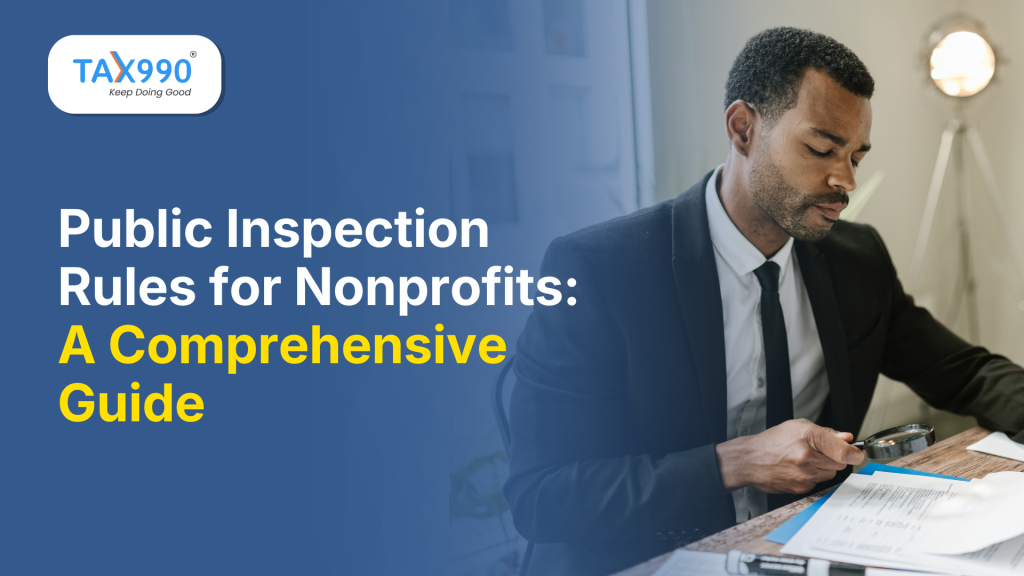
If someone walks into your nonprofit’s office and asks to see your last three years of Form 990s, you are legally required to show them. These aren’t internal documents to keep private, they belong to the public. Public inspection is the legal right of any member of the public to request and review certain official documents filed by tax-exempt organizations.
The IRS public inspection rules exist to hold tax-exempt organizations accountable to the public, and failing to comply can result in penalties, reputational damage, and even jeopardize your exempt status.
Why Public Inspection Rules Exist
Nonprofits receive significant federal and state tax benefits, including exemption from income taxes, the ability to receive tax-deductible donations, access to grants, and reduced postal rates. In exchange, Congress determined that the public deserves a window into how these organizations operate.
Which Organizations Are Covered?
The public inspection rules apply to organizations that are:
- Recognized as tax-exempt under IRC Section 501(c)
- Required to file Form 990, 990-EZ, 990-T, or 990-PF
- Political organizations subject to Section 527
Documents Subject to Public Inspection
1. Annual Information Returns (Form 990, 990-EZ, 990-T, or 990-PF)
Your three most recently filed annual returns must be available. This includes:
- The complete return as filed with the IRS, including all schedules and attachments
- Any amended returns filed for those years
- Form 4720 (Return of Certain Excise Taxes), if applicable
What you may redact: You are permitted (and in some cases required) to withhold certain information:
- Schedule B (Schedule of Contributors): The names and addresses of contributors may be withheld from public copies, though the amounts contributed must remain visible.
- Social Security numbers and similar personal identifiers should always be redacted before disclosure.
2. Application for Tax Exemption (Form 1023, 1023-EZ, 1024, or 1024-A)
Your original exemption application, along with any supporting documents related to the application, must be made available.
What you may redact: Trade secrets, patents, processes, styles of work, or apparatus that, if disclosed, would adversely affect the organization. In practice, this exemption is narrow and rarely applicable.
What Is NOT Required to Be Disclosed?
Not everything in your files is subject to public inspection. The following are generally excluded:
- Donor names and addresses on Schedule B
- Trade secrets and proprietary business information
- Personnel files and individual employee records (beyond what appears on the 990)
- Internal board minutes and governance documents
- Private foundation investment strategies
Penalties for Noncompliance
The IRS takes these obligations seriously. Here’s what’s at stake:
Per-day penalties: If an organization fails to comply with a request for inspection or copies, a penalty of $20 per day applies for each day the failure continues, up to a maximum of $10,000 per return.
Intentional disregard: If the failure is due to willful neglect, the penalty is the greater of $20 per day (with no cap) or 5% of the gross receipts of the organization for the year.
Personal liability: Officers and employees who are responsible for the failure and who acted willfully may face a $20 per-day personal penalty up to $10,000 per return.
State Law Considerations
Many states impose additional disclosure requirements on nonprofits registered to solicit charitable contributions within their borders. These may include:
- Filing annual reports or financial statements with the state charity registration office (many of which are publicly searchable)
- Broader disclosure of donor information in come contexts
- Disclosure of board meeting minutes in certain jurisdictions
Organizations operating in multiple states should review the requirements in each state where they are registered or solicit funds.
Conclusion
Public inspection compliance is one of the most fundamental obligations of tax-exempt status. Meeting these requirements is straightforward for organizations that build simple, consistent practices into their operations. When in doubt, disclose. Your donors, grantmakers, and the communities you serve will thank you for it.
Ready to start filing Form 990? Get started here.

Leave a Comment