

How to Complete the Balance Sheet on Form 990-PF
Estimated reading time: 13 minute(s)
Private foundations carry a level of financial reporting that goes beyond what most exempt organizations file. Form 990-PF asks for a detailed picture of the foundation’s finances, and few sections raise more questions from filers than Part II, the Balance Sheet.
What is Form 990-PF, and Who Files It?
Form 990-PF is the annual return private foundations use to report revenue, expenses, charitable activities, capital gains and losses, officer details, distributable amount, qualifying distributions, and income-producing activities to the IRS. It also determines the tax owed on net investment income. Organizations must file Form 990-PF by the 15th day of the 5th month after their accounting period ends.
What is the Balance Sheet For?
The Balance Sheet gives the IRS insight into how a foundation is structured financially. It requires the book value and fair market value of the foundation’s finances at the beginning and end of the tax year.
Part II is organized into three sections:
- Assets – what the organization owns that has financial value
- Liabilities – what the organization owes
- Net assets or fund balances – assets remaining after liabilities are subtracted
The relationship among the three is straightforward:
| Net Assets or Fund Balances = Assets – Liabilities |
The figures reported in Assets and Liabilities are what determine the Net Assets or Fund Balances total, so accuracy in the first two sections carries through to the third.
Each section includes three columns:
- Book value at the beginning of the year
- Book value at the end of the year
- Fair market value at the end of the year
A note on which columns to complete: foundations with total assets of $5,000 or more at any point during the year must complete all three columns. Foundations with total assets under $5,000 only need to complete the beginning and end-of-year book value columns, plus fair market value on line 16.
Assets (Lines 1-16)
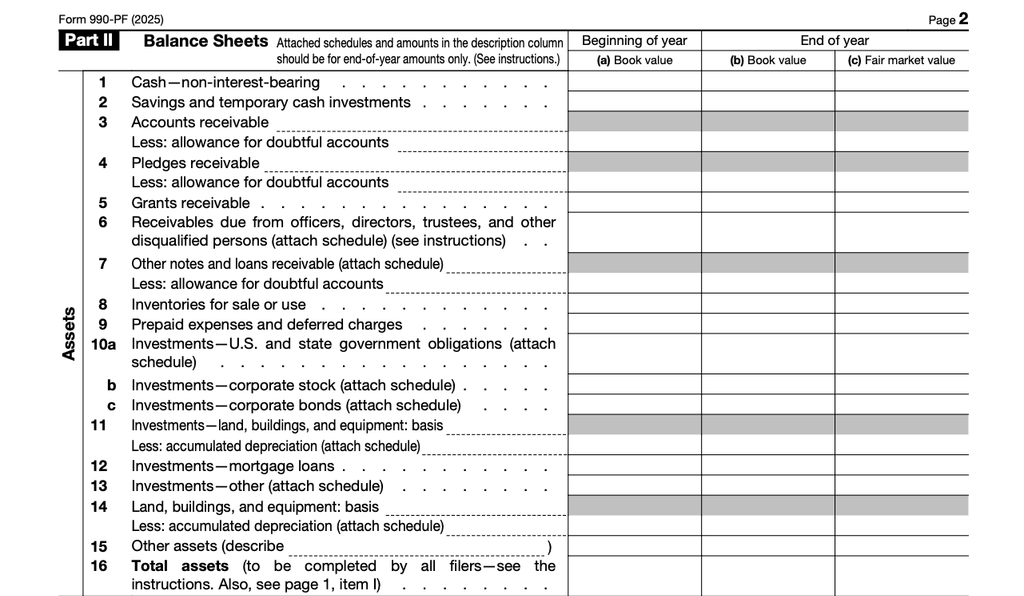
This section reports everything the foundation owns that has financial value. Common examples include:
- Cash, non-interest bearing
- Savings and temporary cash investments
- Accounts, pledges, grants, and other notes and loans receivable
- Receivables due from officers, directors, trustees, and other disqualified persons
- Inventories held for sale or use
- Prepaid expenses and deferred charges
- Investments, including corporate stock and bonds
- Land, buildings, and equipment
Any other assets not covered above can be described directly on the form. Depending on the foundation’s size and the categories reported, additional schedules may be required to fully answer questions in this section.
Once all applicable lines are complete, add lines 1 through 15 and enter the total on line 16.
Liabilities (Lines 17 – 23)

This section reports what the foundation owes at the beginning and end of the tax year. Common examples include:
- Accounts payable and accrued expenses
- Grants payable
- Deferred revenue
- Loans from officers, directors, trustees, and other disqualified persons
- Mortgages and other notes payable
Any additional liabilities should be described on the form. Once complete, add lines 17 through 22 and enter the total on line 23.
Net Assets or Fund Balances
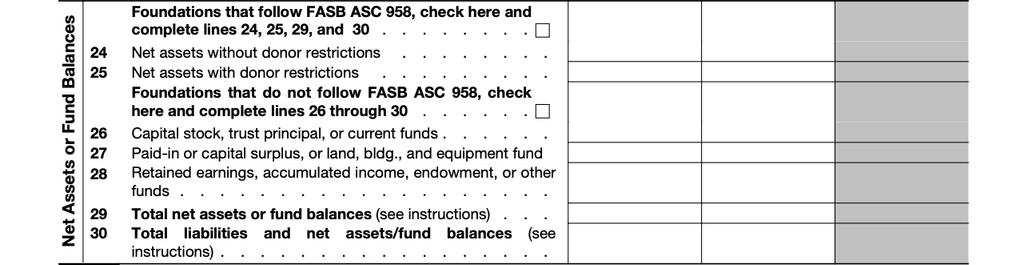
This section reports what’s left after liabilities are subtracted from assets, and which lines apply depends on whether the foundation follows FASB ASC 958 (the accounting standard for nonprofit financial reporting).
Foundations that follow FASB ASC 958 check the corresponding box and complete lines 24 and 25:
- Line 24 – Net assets with donor restrictions
- Line 25 – Net assets without donor restrictions
| Total Net Assets or Fund Balances = Line 24 + Line 25 |
Foundations that do not follow FASB ASC 958 check the corresponding box and complete lines 26 through 28:
- Line 26 – Capital stock, trust principal, or current funds
- Line 27 – Paid-in or capital surplus, or land, building, and equipment fund
- Line 28 – Retained earnings, accumulated income, endowment, or other funds
| Total Net Assets or Fund Balances = Line 26 + Line 27 + Line 28 |
Whichever path applies, the resulting total goes on line 29.
Finally, add total liabilities (line 23) and total net assets or fund balances (line 29) to complete line 30.
| Total Liabilities and Net/Assets/Fund Balances = Line 23 + Line 29 |
This final figure must match the total report on line 16 (Total Assets) for both the beginning and end of the year. If the two don’t match, it’s a sign something on the Balance Sheet needs a second look before filing.
Let Tax990 Simplify Your Form 990-PF Filing
Form 990-PF asks a lot of any organization, and the Balance Sheet is one of its more detail-heavy sections. Tax990 is built to carry that complexity so your foundation’s team doesn’t have to become tax experts to file accurately.
Ready to complete your foundation’s Form 990-PF? Start filing with Tax990 today.
Leave a Comment