

- Posted inin Form 990
The Governance Questions on Form 990 Part VI, Answered for Nonprofit Boards
- Posted byPatience Booker
- 0 Comments
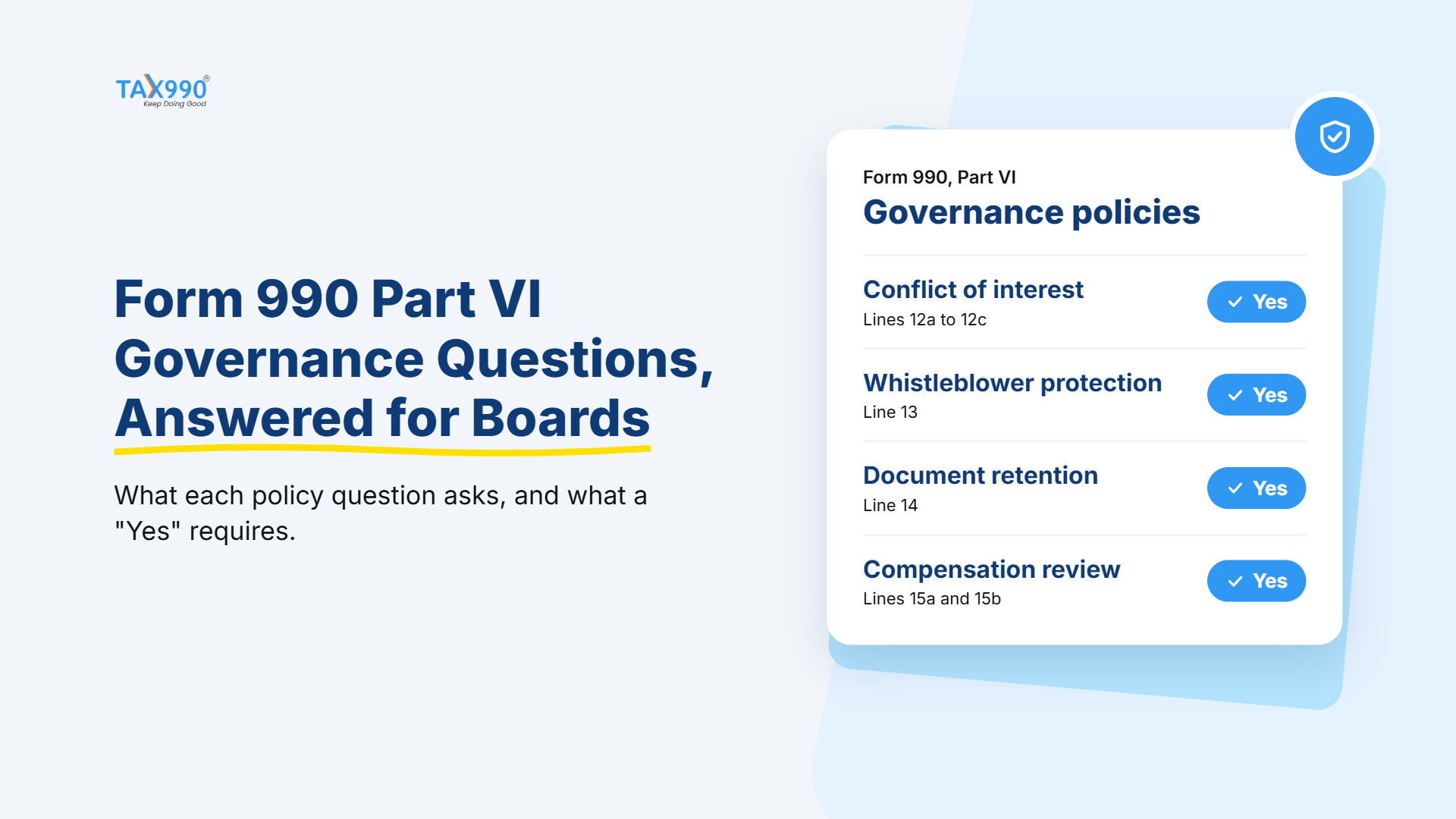
Every year, your organization’s Form 990 tells the public whether your board has a conflict of interest policy, a whistleblower policy, a document retention policy, and a real process for setting executive pay. Those answers sit in Form 990 Part VI, and most boards never read them before the return is filed.
Form 990 Part VI is the governance section of the return, where an organization reports how its governing body is structured, which governance policies it has adopted, and how it makes key documents available to the public.
Here’s what Part VI asks, what a “Yes” requires, and how your board can get ahead of the answers. For a broader walkthrough of the sections around it, see our guide to Form 990 Parts 4 through 6.
Are Form 990 Part VI Policies Required by the IRS?
No. Section B of Part VI states on the face of Form 990 that it requests information about policies not required by the Internal Revenue Code. Your organization can answer “No” to every policy question without breaking federal tax law.
The answers still matter. Grantmakers, donors, and journalists read Part VI as a snapshot of how seriously a board takes its fiduciary duty. A string of “No” answers tells them something, whether or not it’s the full story. State law or funder agreements may require some of these policies, so confirm with counsel.
Who Can See Your Part VI Answers?
Anyone. Section 6104 of the Internal Revenue Code requires an organization to make its Form 990 available for public inspection, and the obligation generally covers the three most recent returns. Online nonprofit databases republish filed returns, so your answers are a search away.
Line 18 asks how you made your returns available (your own website, another website, or upon request). Line 19 asks you to describe on Schedule O whether, and how, you made your governing documents, conflict of interest policy, and financial statements available to the public.
What Part VI Asks About the Board Itself
Section A starts with the board. Line 1a asks how many voting members the governing body had at the end of the tax year, and line 1b asks how many of them are independent. Line 2 asks whether any officer, director, trustee, or key employee had a family or business relationship with another. Readers often check these lines first, since a small or closely connected board can make oversight harder.
The Four Governance Policies on Form 990 Part VI
| Policy | Part VI line | What the IRS asks |
| Conflict of interest | 12a, 12b, 12c | Is there a written policy? Must officers, directors, trustees, and key employees disclose potential conflicts annually? Does the organization regularly and consistently monitor and enforce compliance? |
| Whistleblower protection | 13 | Is there a written whistleblower policy? |
| Document retention and destruction | 14 | Is there a written document retention and destruction policy? |
| Compensation review | 15a, 15b | Did the process for setting pay include review and approval by independent persons, comparability data, and contemporaneous substantiation? |
Conflict of Interest Policy (Lines 12a to 12c)
This is the only policy Part VI asks about three times. A written policy answers line 12a, but lines 12b and 12c ask whether the policy works in practice: whether leaders disclose potential conflicts every year, and whether the organization monitors and enforces it. A “Yes” on line 12c also requires a description on Schedule O of how the organization did that.
In practice, that usually means an annual disclosure form signed by each board member and key employee, plus minutes showing conflicted members stepped out of related votes.
Whistleblower Policy (Line 13)
A whistleblower policy gives staff and volunteers a safe way to report suspected financial misconduct or other wrongdoing, and it protects them from retaliation for reporting in good faith. Line 13 asks only whether the policy exists in writing. Your board should still confirm who receives reports when the concern involves the executive director.
Document Retention and Destruction Policy (Line 14)
This policy sets how long the organization keeps each type of record, how it destroys records once that period ends, and when destruction stops, such as during an audit, investigation, or lawsuit.
Compensation Review (Lines 15a and 15b)
Line 15a covers your top management official, and line 15b covers other officers and key employees. Each asks whether the pay-setting process included all three elements: approval by independent persons, comparability data, and contemporaneous documentation of the decision.
Those three elements mirror the rebuttable presumption of reasonableness in the Treasury regulations on excess benefit transactions under section 4958. When a board follows that process, the IRS generally bears the burden of showing that compensation was unreasonable.
How Can Boards Prepare Before Form 990 Is Filed?
Line 11a asks whether the organization provided a complete copy of Form 990 to every member of its governing body before filing, and line 11b asks you to describe the review process on Schedule O. The IRS explains why it asks about board review. Tax990 can help here, with a guide to sharing your completed Form 990 with your board. A short annual routine makes both answers easy:
- Schedule the review. Put Form 990 on the board or finance committee agenda before the filing deadline.
- Confirm each policy is written and adopted. Locate the minutes that adopted each policy and note its last review date.
- Collect annual conflict disclosures. Gather signed statements from every board member and key employee before the fiscal year closes.
- Document compensation decisions when they’re made. Record the comparability data, approvers, and date in that meeting’s minutes.
- Decide how documents are shared. Choose how you’ll make returns and policies available, so lines 18 and 19 describe a real practice.
Treat Part VI as Your Public Governance Report
The answers protect donor trust when they reflect policies the board adopted, understands, and follows. If a filed return misstates a policy, you can amend Form 990 to correct the record.
Reviewing Part VI each year turns a compliance section into a stewardship habit, and it means your board is never surprised by what the public can already read.
Ready to file?
Tax990 supports Form 990 with a guided workflow, built-in error checks, and free retransmission of rejected returns. Every return is backed by the Tax990 Commitment, and Protection Plus audit defense is included automatically at no additional cost.
E-file Form 990 with Tax990 or create your free Tax990 account.
Recent Posts
- The Governance Questions on Form 990 Part VI, Answered for Nonprofit Boards
- Tax990 Verification Code Not Arriving? Here’s What to Do
- Did Your IRA Receive a K-1? Here’s What You Need to Do Next
- Beyond Form 990: The Other Returns Nonprofits Still Have to File
- How to Get a Copy of Your 501(c)(3) Letter (If You Lost It)