Most tax-exempt organizations never pay federal tax on the money their investments earn. Private foundations are the exception. Every year, a private foundation calculates and pays an excise tax on its net investment income, and it reports that tax on Form 990-PF.
The private foundation excise tax is a 1.39 percent federal tax on a private foundation’s net investment income, imposed under Internal Revenue Code section 4940 and reported in Part V of Form 990-PF. Here’s how the calculation works and where foundations most often get it wrong.
Who Files Form 990-PF and Why the Tax Applies
Form 990-PF is the annual return for private foundations and for nonexempt charitable trusts treated as private foundations under section 4947(a)(1). Public charities file Form 990, 990-EZ, or 990-N, while private foundations file Form 990-PF every year regardless of gross receipts or asset size. For a refresher on how the IRS sorts foundations, see our guide to IRS classifications and filing requirements for private foundations.
Private foundations usually draw their funding from one family, individual, or company rather than broad public support, so Congress placed them under stricter rules in the Tax Reform Act of 1969. The excise tax on investment income is one of those rules. Public charities don’t pay it, and neither do exempt operating foundations, a small group of operating foundations that have been publicly supported for at least 10 years and meet governing body tests.
What Is the Private Foundation Excise Tax Rate?
The private foundation excise tax rate is 1.39 percent of net investment income. That flat tax on net investment income applies to tax years beginning after December 20, 2019. Before that, foundations paid 2 percent, with a reduced 1 percent rate available to those meeting a distribution test. The rate remains 1.39 percent after the 2025 tax legislation.
What Counts as Net Investment Income?
Under section 4940, net investment income is gross investment income plus capital gain net income, minus allowable deductions. Each piece has its own rules.
Gross Investment Income
Gross investment income includes:
- Interest, including interest on program-related loans such as student loans
- Dividends
- Rents
- Royalties
- Payments on securities loans
- Income from similar sources
It excludes tax-exempt interest on governmental obligations, such as municipal bonds, and any income already taxed as unrelated business income on Form 990-T. Our overview of Form 990-T and unrelated business income tax explains where that line falls.
Capital Gain Net Income
Capital losses can offset capital gains in the same year, but a net capital loss can’t reduce other investment income, and it can’t be carried back or forward.
Allowable Deductions
A foundation may deduct the ordinary and necessary expenses it pays to produce or collect investment income or to manage investment property, such as investment advisory fees, custodial fees, and the investment share of staff time. Depreciation is limited to the straight-line method. Grants, program expenses, net operating losses, and corporate special deductions like the dividends-received deduction aren’t allowed.
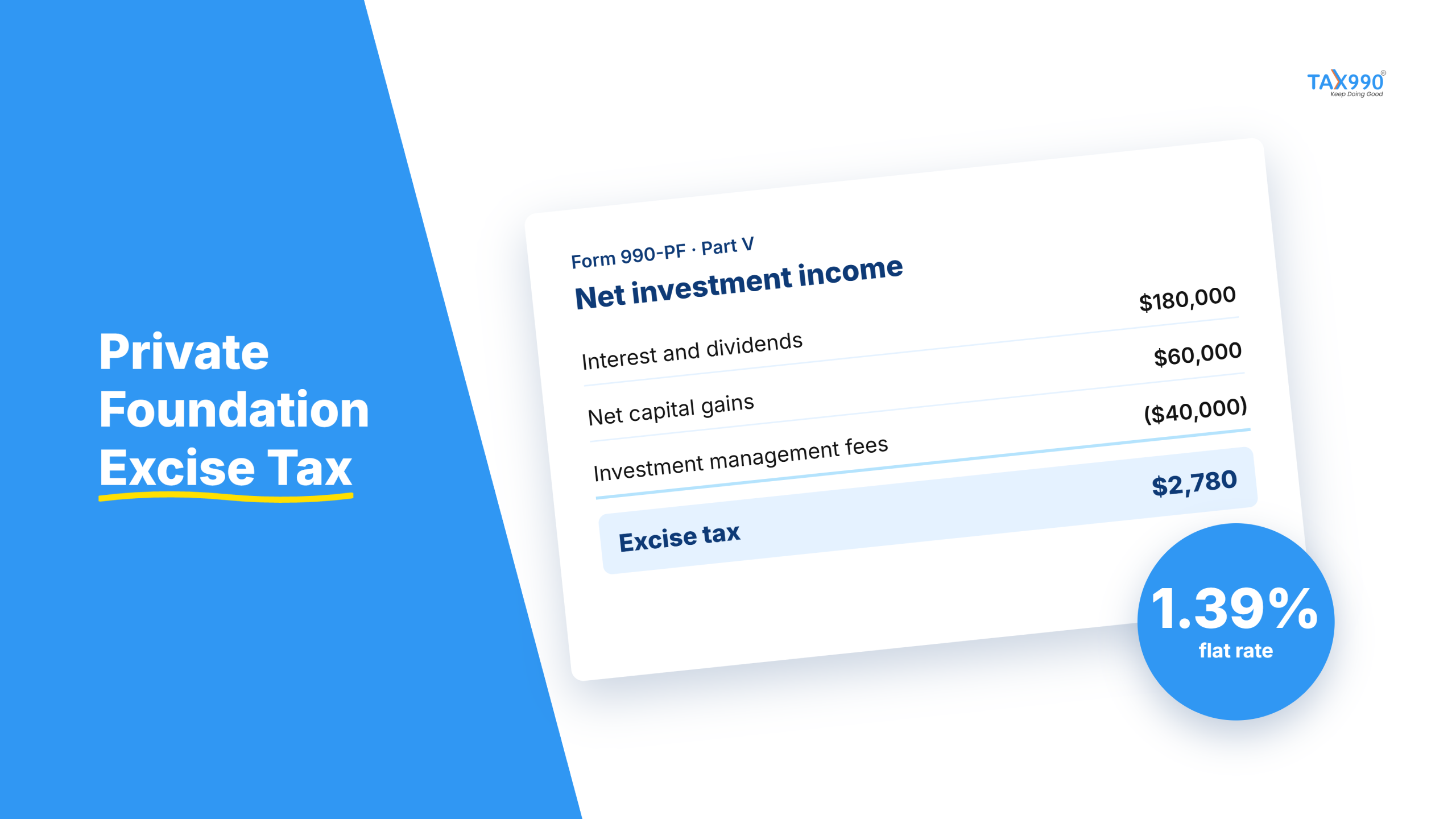
A Simple Example
| Line item | Amount |
|---|---|
| Interest and dividends | $180,000 |
| Net capital gains | $60,000 |
| Investment management fees | ($40,000) |
| Net investment income | $200,000 |
| Excise tax at 1.39 percent | $2,780 |
You’ll enter the income and expense figures in column (b) of Part I, and the tax itself in Part V. Our step-by-step guide to Form 990-PF Parts V through VIII walks through those lines.
Common Private Foundation Excise Tax Calculation Mistakes
Watch for these six errors:
- Using the old rate. Spreadsheets and templates built before 2020 may still apply 2 percent or the 1 percent reduced rate.
- Using the wrong basis on donated assets. For property a foundation received as a gift, gain is generally figured using the donor’s original basis, not the fair market value on the date of the gift. Using the gift-date value understates the gain.
- Netting capital losses against dividends or interest. Losses only offset gains, and they don’t carry over to the next year.
- Deducting charitable expenses. Grants and program costs count toward your distribution requirement, not against your net investment income.
- Not allocating shared costs. Salaries, rent, and other expenses that support both investments and programs must be split, and only the investment share is deductible.
- Skipping estimated tax payments. A foundation that expects its section 4940 tax, minus credits, to be $500 or more must make estimated payments through the Electronic Federal Tax Payment System (EFTPS). For calendar-year foundations, installments are due May 15, June 15, September 15, and December 15. Missing them can trigger an underpayment penalty figured on Form 2220. A tax under $500 can be paid in full by the original, not extended, due date of the return.
Calendar-year foundations should also track the May 15 filing deadline, covered in our complete guide to Form 990 deadlines.
Is This the Only Excise Tax Private Foundations Face?
No. The tax on net investment income is the one every taxable private foundation pays each year. The others apply only when a foundation breaks a specific rule.
| Section | Excise tax | Triggered by |
| 4941 | Self-dealing | Certain transactions with disqualified persons |
| 4942 | Undistributed income | Not meeting the annual minimum distribution |
| 4943 | Excess business holdings | Owning too much of a business |
| 4944 | Jeopardizing investments | Investments that put charitable assets at risk |
| 4945 | Taxable expenditures | Spending on prohibited purposes |
The IRS overview of private foundation excise taxes covers each in more detail.
File Form 990-PF With Confidence
Tax990’s guided Form 990-PF workflow includes built-in error checks that flag calculation issues before you transmit. Every return is backed by the Tax990 Commitment: IRS acceptance or your money back, plus free amendments (up to three) and retransmissions. Protection Plus is included automatically at no additional cost, providing up to $1 million in professional audit defense for up to three years after IRS acceptance. Read more about private foundation filing requirements.
Still Deciding Between a Private Foundation and a Public Charity?
If your organization is still choosing its structure, read What Is the Difference Between a Public Charity and a Private Foundation? It compares funding sources, filing obligations, and tax treatment side by side.
Ready to file Form 990-PF?
E-file Form 990-PF with Tax990 or see transparent Form 990-PF pricing.
Recent Posts
- Private Foundation Excise Tax on Net Investment Income: A Form 990-PF Guide
- Group Exemption Numbers and Form 990: Filing Requirements for Subordinate Organizations
- Understanding the 990-N Form: A Guide for Small Nonprofits
- Introducing 990-N Full Service: Our Experts Will File Your Form 990-N for You
- Choosing a Form 990 E-File Provider: What to Compare Beyond Price