
- Posted inin how to
Reasonable Cause Penalty Abatement: How to Write a Letter the IRS Will Accept
- Posted byPatience Booker
- 0 Comments
A late-filing penalty notice can be stressful, especially when the delay happened for reasons your team couldn’t control. The good news is that the IRS offers penalty abatement for reasonable cause. The letter you send makes that case, so it’s worth writing it well.
What Does Reasonable Cause Mean to the IRS?
Reasonable cause is the IRS standard for removing a penalty when an organization used ordinary business care and prudence but still couldn’t file or pay on time because of circumstances outside its control. The IRS decides each request on its own facts.
That’s different from explaining a delay. “Our treasurer was busy” explains why the return was late. A reasonable cause letter has to show that your organization had a sound process, that something outside that process stopped it, and that you filed as soon as you could.
This matters more for nonprofits than many people realize. First-time abatement, the IRS’s automatic relief for taxpayers with a clean history, generally doesn’t apply to Form 990 late-filing penalties. For most organizations, a reasonable cause request is the main path to relief. You can see the current penalty amounts on our Form 990 late filing penalties page.
What Should a Reasonable Cause Penalty Abatement Letter Include?
A strong IRS penalty abatement letter answers three questions in order.
- What happened? Give dates. When did the problem start, how long did it last, and when did you file? Vague timelines are a common reason for requests to stall.
- Why was it outside your control? Connect the event directly to the missed deadline. If your executive director was hospitalized, explain that she was the only person with access to the financial records and that no one else could complete the return.
- What changed to prevent it from happening again? Show the IRS the problem is fixed. Name a backup signer, a shared records system, or a new filing calendar the board reviews each year.
Back each point with documents, such as hospital records with dates, disaster declarations, insurance claims, board minutes, or correspondence showing you tried to get missing information.
Which Reasons Does the IRS Accept or Reject?
| Usually accepted | Usually rejected |
| Death, serious illness, or unavoidable absence of the person responsible for filing | Forgetting the deadline or simple oversight |
| Fire, natural disaster, or other casualty | Relying on a preparer or volunteer to file on time |
| Inability to get records despite diligent effort | Not knowing the organization had to file |
| System issues that delayed a timely e-filing | Lack of funds, on its own |
The rejected column trips up a lot of organizations. Using a paid preparer doesn’t shift the responsibility for a complete, accurate, on-time return away from your organization. Volunteer turnover is common, and the IRS knows it. On its own, though, turnover reads as a process gap, not an event outside your control.
How Do You Submit a Penalty Abatement Request?
File the late return first if you haven’t already. Then send your written statement in response to the penalty notice, using the address or phone number on the notice. For Form 990 and 990-PF, you can also attach a reasonable cause statement when you e-file a late return. If you’d rather use a form, our guide to Form 843 for nonprofits walks through it.
For the full process, from filing the late return to what happens after relief is granted, see our guide to reasonable cause relief for late Form 990 filing.
A Reasonable Cause Letter Template You Can Adapt
Use this structure as a starting point and fill in your own facts. Keep it to one or two pages.
- Header: Organization name, EIN, address, tax period, form number, and the notice number and date.
- Request: One sentence asking the IRS to abate the penalty of $[amount] for the tax period ending [date] based on reasonable cause.
- What happened: Two to four sentences with specific dates describing the event.
- Why it was outside your control: How the event prevented a timely filing, and what your normal process was before it happened.
- What you did: The steps you took once the problem arose, and the date you filed.
- What changed: The specific safeguards now in place.
- Attachments: A list of supporting documents.
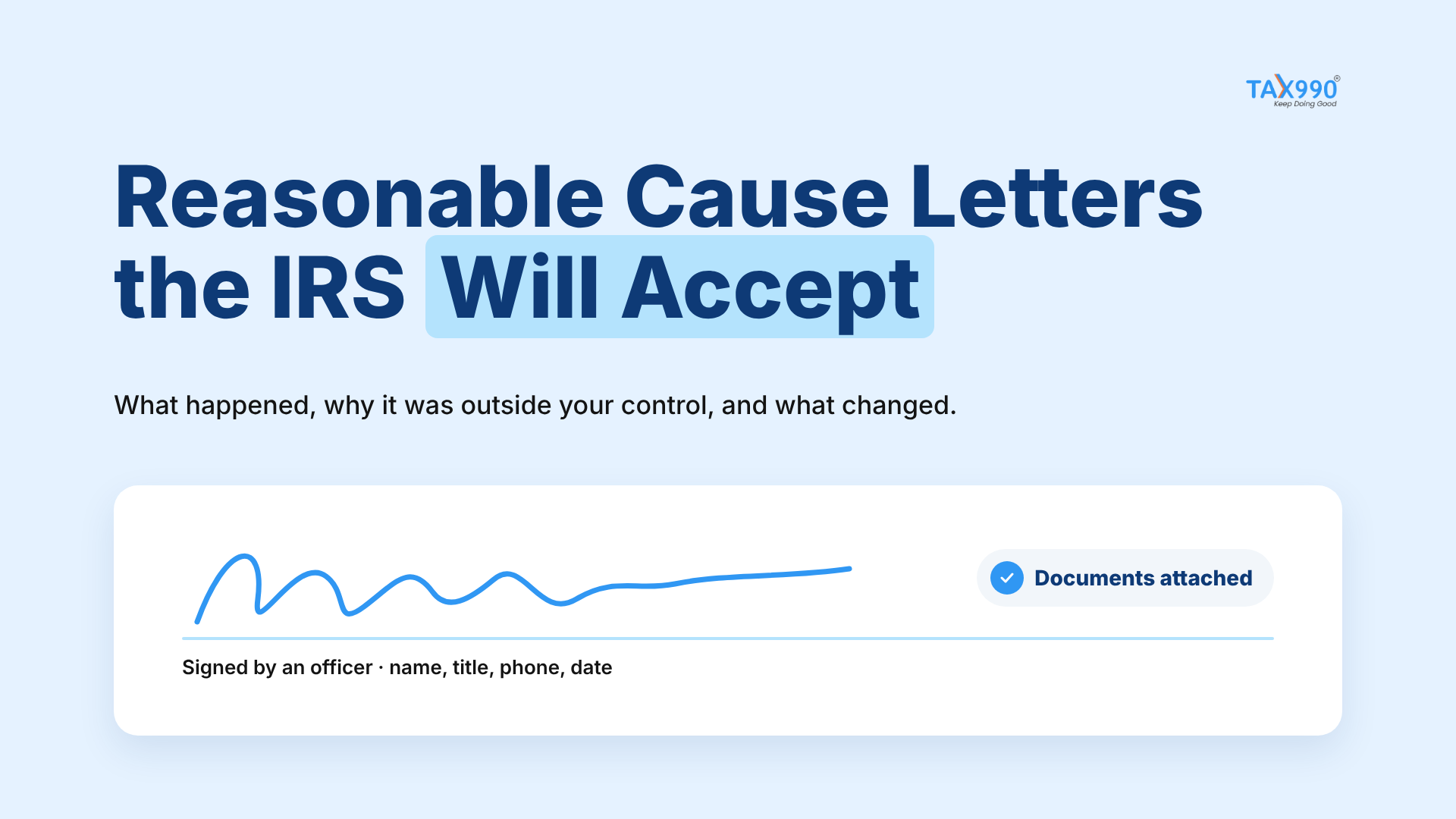
- Signature: Signed by an officer, with name, title, phone number, and date.
Send it by certified mail and keep a copy of everything.
Avoid the Penalty Next Year With Tax990
The strongest abatement letter is the one you never need to write. Tax990’s guided workflow and built-in error checks help catch issues before you transmit, and if the IRS rejects a return, you can fix and retransmit it at no additional cost. Form 8868 extensions are included with the Tax990 Commitment, so an unexpected delay doesn’t have to become a penalty. Every return is backed by the Commitment’s IRS acceptance or money-back guarantee, and Protection Plus audit defense is included automatically.
If your letter’s “what changed” section needs a concrete answer, switching to a filing process with built-in checks and a clear record of every submission is a good one.
Ready to file? Create your free Tax990 account or see transparent Form 990 pricing.
Recent Posts
- Reasonable Cause Penalty Abatement: How to Write a Letter the IRS Will Accept
- How to Report a Nonprofit Name Change to the IRS
- Nonprofit Document Retention Policy: A Free Template and the Form 990 Question It Answers
- The Governance Questions on Form 990 Part VI, Answered for Nonprofit Boards
- Tax990 Verification Code Not Arriving? Here’s What to Do